
Suda51 (aka Goichi Suda) is supposedly an eccentric creator. I say "supposedly" because my exposure to his creations to date has been limited to a few minutes of hands-on gameplay from Shadows of the Damned. He is known as an uncompromising mind who combines the mundane with surreal scenarios and has been described by many as the Tarantino of gaming. ROMEO IS A DEAD MAN (RIADM from here on out) is the latest game he has delivered with his personal vehicle, Grasshopper Manufacture. We are here to find out how much it lives up to his reputation.
Romeo is a bewildered man
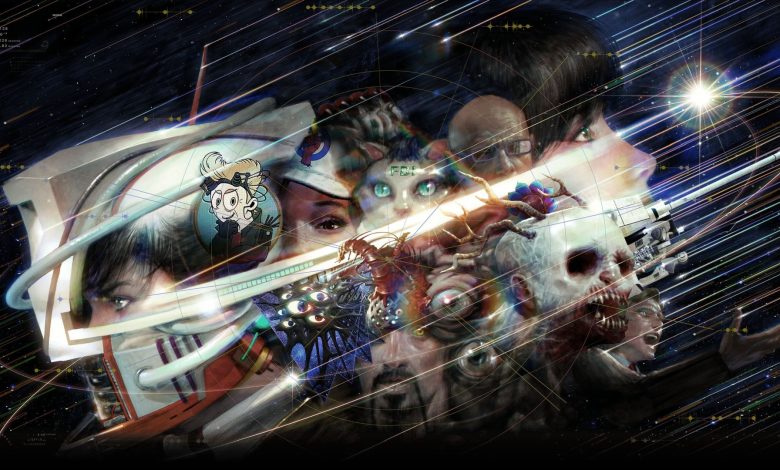
Romeo Stargazer works as a sheriff's deputy in Deadford, a small town where nothing ever happens and boredom could be considered a felony. However, two fateful night patrols will change the protagonist's life forever. On the first, he finds a girl with amnesia, Juliet, lying unconscious on the street. It's love at first sight. On the second, he finds a mutilated body and, at the same time, death, as the hideous predator lurks nearby. Just before he breathes his last, his grandfather Benjamin (also the genius who invented the first time machine) appears through a portal and brings him back to life by grafting a helmet on him. When he wakes up, he learns that he has been recruited by the Space-Time Police to help fight serious crimes. So the guy died and they brought him back to life to continue working. Sorry, I was thinking of someone else... As if that weren't enough, he learns that his beloved Juliet has disappeared and may be involved in events that are dangerously distorting space-time.

The game has a peculiar, strange feel to it. The fact that his grandfather continues to live on as... a stitched-on motif on the back of his jacket and gives him advice about the situations at hand, could be deemed as ordinary. You're never sure what's going to happen next. The dialogues in certain situations are sarcastic, break the fourth wall, and impart a naive essence, but I'm almost certain that the latter is intentional. It's like a fever dream, where situations seem surreal and out of context, but you suspect that there is more to them than meets the eye. They may later entwine in a shared narrative thread, or they may not. To be honest, it reminded me to some extent of the bizarre experience of another non-conformist Japanese director. RIADM, although it uses some elements from Shakespeare's play of the same name, is used here as a means to tell a different story. I'm not sure if there is a correct interpretation in the end, but one thing was certain: this bizarre sci-fi medley kept me hooked to my screen for hours.

Romeo is a robust man
The outlandish setting of RIADM hides a relatively ordinary gameplay. Romeo is an action game that emphasizes battles with numerous opponents, while there are also occasional puzzles, which are nothing special. The story unfolds linearly, with the protagonist visiting different locations at different times in order to find the criminal who is disrupting the space-time continuum and arrest them or, if they resist, kill them (spoiler alert: they always resist). Each location is essentially a mission. In general, the gameplay loop is: from our ship, which acts as a hub, we travel to the location, search for clues about the criminal's background, confront them, and return to the hub.

Between us and him, there are various physical obstacles, which we can open up through subspace. At specific points, televisions appear, through which we can enter a parallel dimension, a hallucination made from neon grid. There, by removing obstacles or finding new TVs, we gain access to previously inapproachable places in the real world. The subspace starts out fairly simple, but as we progress, it becomes more maze-like. Within the real world, we will face the game's common enemies, the Rotters. They come in various shapes and sizes: small ones that look like zombies, large ones that look like chubby demons, swollen monsters that leave pools of toxic liquid behind, etc. The highlight of the design, of course, is the game's bosses, which are somewhere between weird and grotesque.

The patterns of all enemy attacks are distinct, while the difficulty is scaling properly. Romeo's responsiveness is good, and the combos are fairly simple, alternating between fast and powerful attacks, continuous attacks of the same type, and so on. Don't expect the same depth you would see in AAA character action productions. Overall, RIADM felt like a dungeon crawler to me, with the various maps providing a wealth of rewards in consumables and upgrades (sentreys). The latter can be used in the hub or at save spots to upgrade our weapons. New weapons—we start with two, one melee and one ranged—can be purchased with the flowsion left behind by defeated opponents. As a Grasshopper game, their quirky style would inevitably find its way into the gameplay mechanics to some extent. For example, character leveling is done through an arcade mini-game. In it, we pilot a ship through a maze, where power-ups are scattered around that strengthen melee attacks, increase the life bar, make reloading faster, etc. Flowsion acts as fuel for the ship, so we have to pan the camera around to plan the ideal route each time, the one that will get us the most upgrades with the least fuel.
Among these smaller details, I would like to highlight the one concerning the Bastards. Instead of the game directly providing us with certain activated abilities (AoE attacks, slowing down time, turrets, etc.), we receive seeds as loot, which we plant on the ship. These produce various critters that we can summon into battle to help us with the aforementioned abilities when things get dicey. We can make them fight each other to create a more powerful one, with the abilities of the one with the highest level or a completely new one. Both the leveling process and the "gardening" feature of the Bastards may seem like quirks, but I personally found them charming and spent quite a bit of time with them.

Romeo is an unrefined man
Unfortunately, the game suffers from serious technical issues. At first, specifically during the first 3-4 hours, they are not noticeable, but as you progress, they become more and more apparent. We are not talking about occasional frame rate drops or the usual Unreal Engine 5 traversal stuttering. Without being able to say for sure what causes it, quite often, the frames drop to single digits (you read that right) and remain stuck there for several seconds. Even if the action "unfreezes" for a moment, the problem is likely to recur shortly thereafter. I should mention that there were scenes that under normal circumstances I would have gotten through in 1 minute, but because of this problem, the time it took to get through them could double.

Unfortunately, no matter how much I tweaked the settings, lowering them, activating FSR, etc., it made absolutely no difference. It's probably caused by the abundance of particles during combat, but in no way does that justify this situation. On the same system, I had completed two full playthroughs of Silent Hill f, which uses the same engine and runs much better. ROMEO IS A DEAD MAN does not reach the levels of detail of that game, while I would describe its environments as bland and lifeless. The music is the only saving grace of this debacle. From the Japanese rap in the intro to the rock riffs in the boss battles and the paranoid jazz played in the subspace, the soundtrack is an eclectic mix of music and sounds that reinforces the game's wacky concept.

What remains in the end is a bittersweet taste. I had no specific expectations for Romeo, due to my minimal exposure to Suda51's works. However, while it managed to win me over, my enjoyment turned gradually to discontent, and then to frustation. A patch to improve performance is essential, as it is a shame for this otherwise remarkable game to be tarnished in such a manner.


ΒΑΘΜΟΛΟΓΙΑ - 57%
57%
Romeo is a broken man
Interesting, wild, with its own distinct style and personality, but the dismal performance makes it very difficult to enjoy...