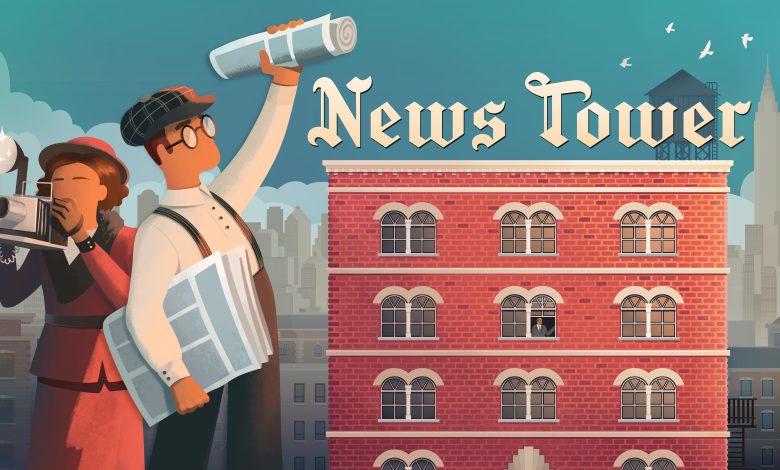

Say pal, you grab a newspaper from the stand, flip it open, and read the headlines of the main reports in the "front section": New tariffs from the US President, economic uncertainty, the rise of the far-right in Europe, mob hits in bars. We are, of course, talking about the 1930s, the golden age of print media, which serves as the thematic backdrop for News Tower, a new tycoon game and the dynamic debut from the developer Sparrow Night.
The tycoon game genre once reigned supreme on the personal computer platform as one of the most robust genres. It raised many of us, especially during the late 90s, when it peaked in various thematic implementations. Thematically, one of the genre's favourite eras was the turn of the 19th to the 20th century, with all the great technological discoveries that rapidly changed the speed of transmission and the way information was consumed. Capitalist production and its inherent contradictions always generate a particularly interesting gameplay context that, on the one hand, is alluring with the pleasure caused by Fordist/Taylorist organisation and the drive for maximisation of efficiency, and on the other hand, calls the player to manage the demands of employees and the interference of competitors as challenges.
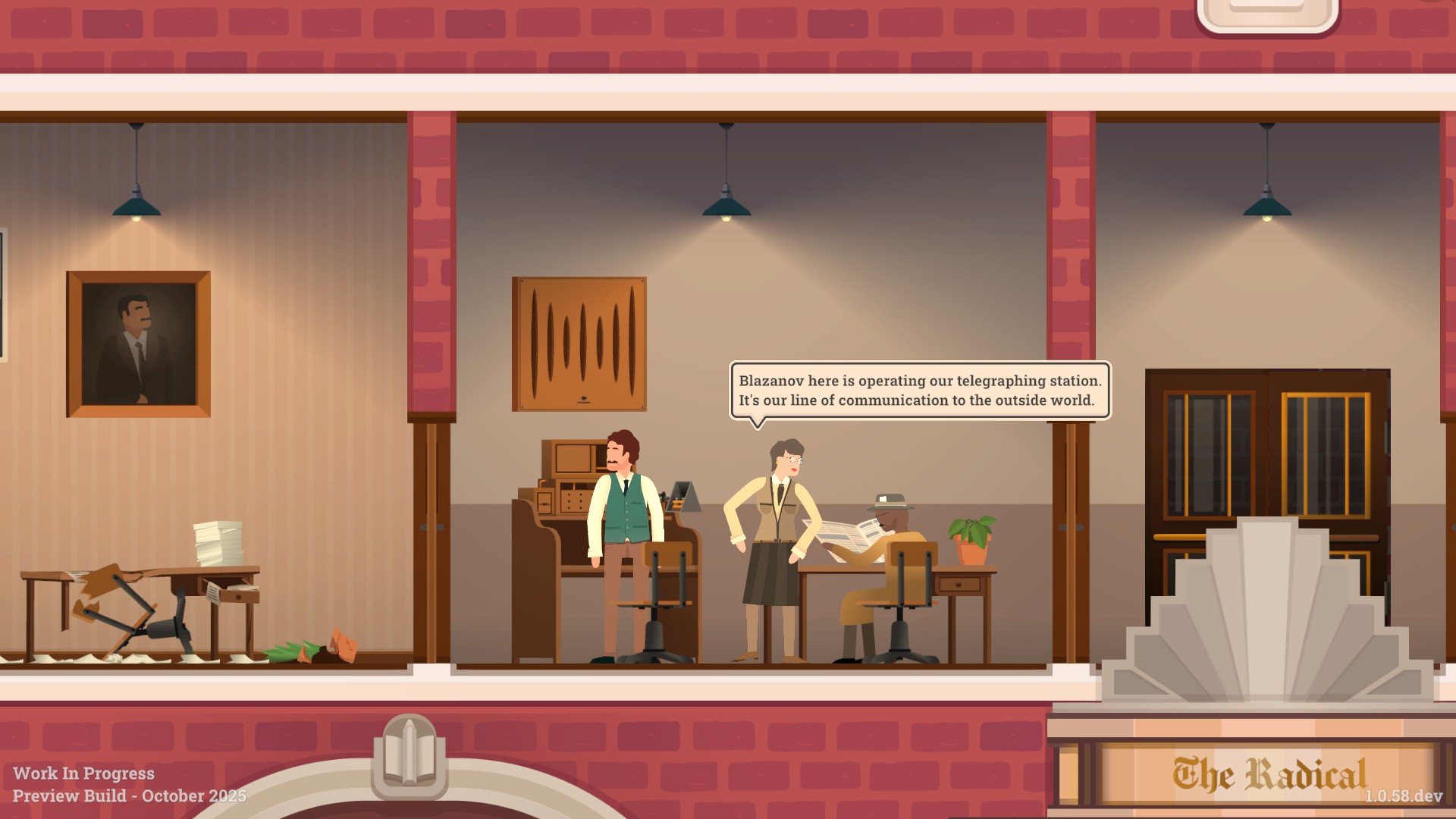
News Tower is a spiritual successor to Sim Tower (1994) and the more recent Project Highrise (2016). The main mechanism is the vertical development of a business—in this case, a newspaper—and the expansion of the production line within the limited space of each floor, aiming to maximise the efficiency of every square metre and optimise the production line. Thematically, News Tower uses an era that is voluminous in visual aesthetics, but one that is also full of deep problems and conflicts. It begins the day after Black Thursday in 1929, when the US stock markets collapsed, and extends until 1939, when the vortex of events led to yet another world war. During its development, the Early Access model was chosen, something about which I am generally quite sceptical unless we are talking about brilliant exceptions. Although I took on the presentation of the game for the 1.0 release, I took a brief look back at the EA journey and must say that I formed a very positive impression of the creators' presence and interaction with the community. Today, upon its release, the title stands rich with numerous expansions compared to its initial form, and communication with the community is lively and substantial.
Starting in 1929, we have the option to choose whether to begin with a Tutorial or not. I believe the provided assistance is necessary and welcome, as the initial information can be overwhelming. The first mechanism we master is researching the news via telegraph and sending reporters to cover the story. After the appropriate reporter covers the news, they return to headquarters with the text in hand and deliver it to the typesetter for transcription. Once all editing procedures are complete, the article ends up in the editor-in-chief's final selection and takes its place in the formation of the newspaper's front page. Since each of our editions is weekly, the final design and printing of the newspaper take place every Sunday. Any news that did not manage to be processed is necessarily carried over to the following week as "stale news."
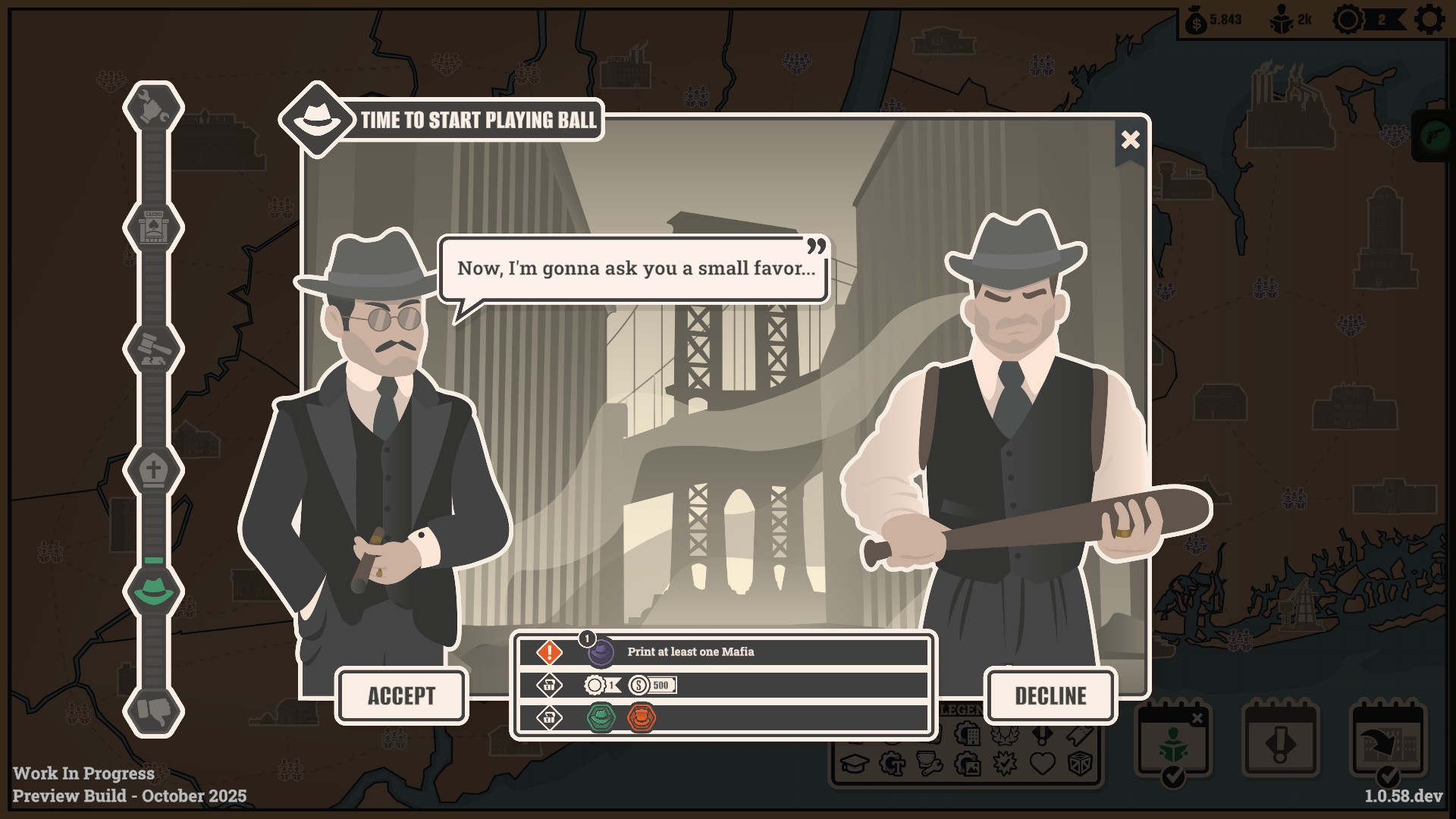
Our field of action is New York City and its surrounding areas. Each week, before doing anything else, we lock in a demographic in an adjacent neighbourhood with the goal of winning them over as subscribers. This is achieved by covering one of that specific neighbourhood's special interest topics in the next issue. For example, a working-class neighbourhood might want to read about boxing sports stories and news about revolts and social unrest. If we cover both of their requirements, we gain them as subscribers, now having a stable and predictable income and, crucially, unlocking the next adjacent areas that lead either to new subscribers or to city landmarks. The landmarks function either as centres where we can buy new technology or equipment for our publishing house, or, even more importantly, as headquarters for one of the game's factions. These factions contact us, requesting or demanding various favours regarding how the news is covered, offering money or influence. Obviously, one of the factions is the Mafia, the others are the Mayor's Office, the "High Society," and finally, the Army. They operate competitively in pairs. For example, when our newspaper publishes a rigged match by the Mafia as a front-page story, the Mayor's Office's estimation of us automatically drops. Ultimately, when a faction's estimation is exhausted, it becomes permanently locked. Thus, it becomes important for each playthrough which alliances we will pursue to receive the exclusive benefits of the higher tiers.
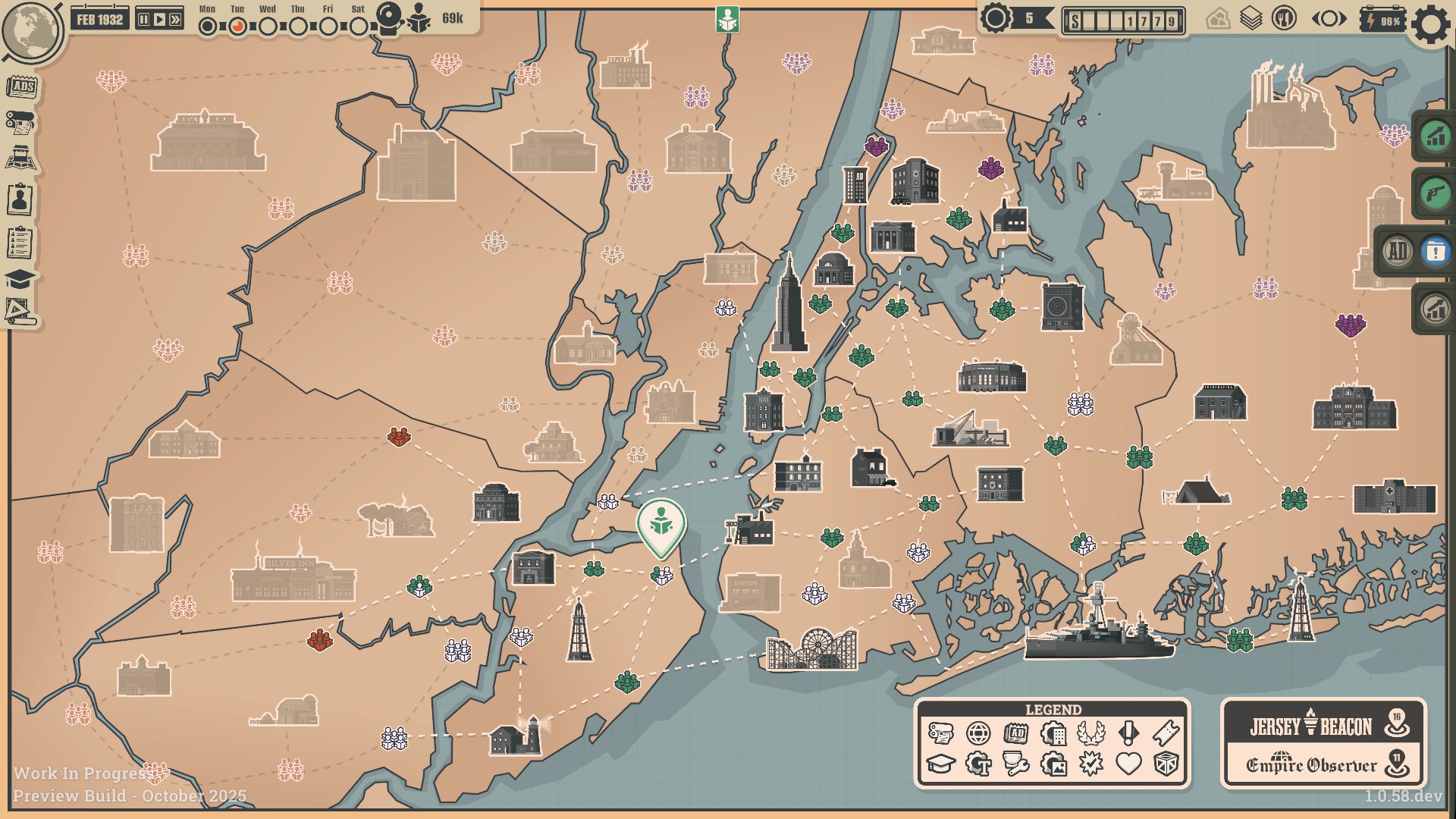
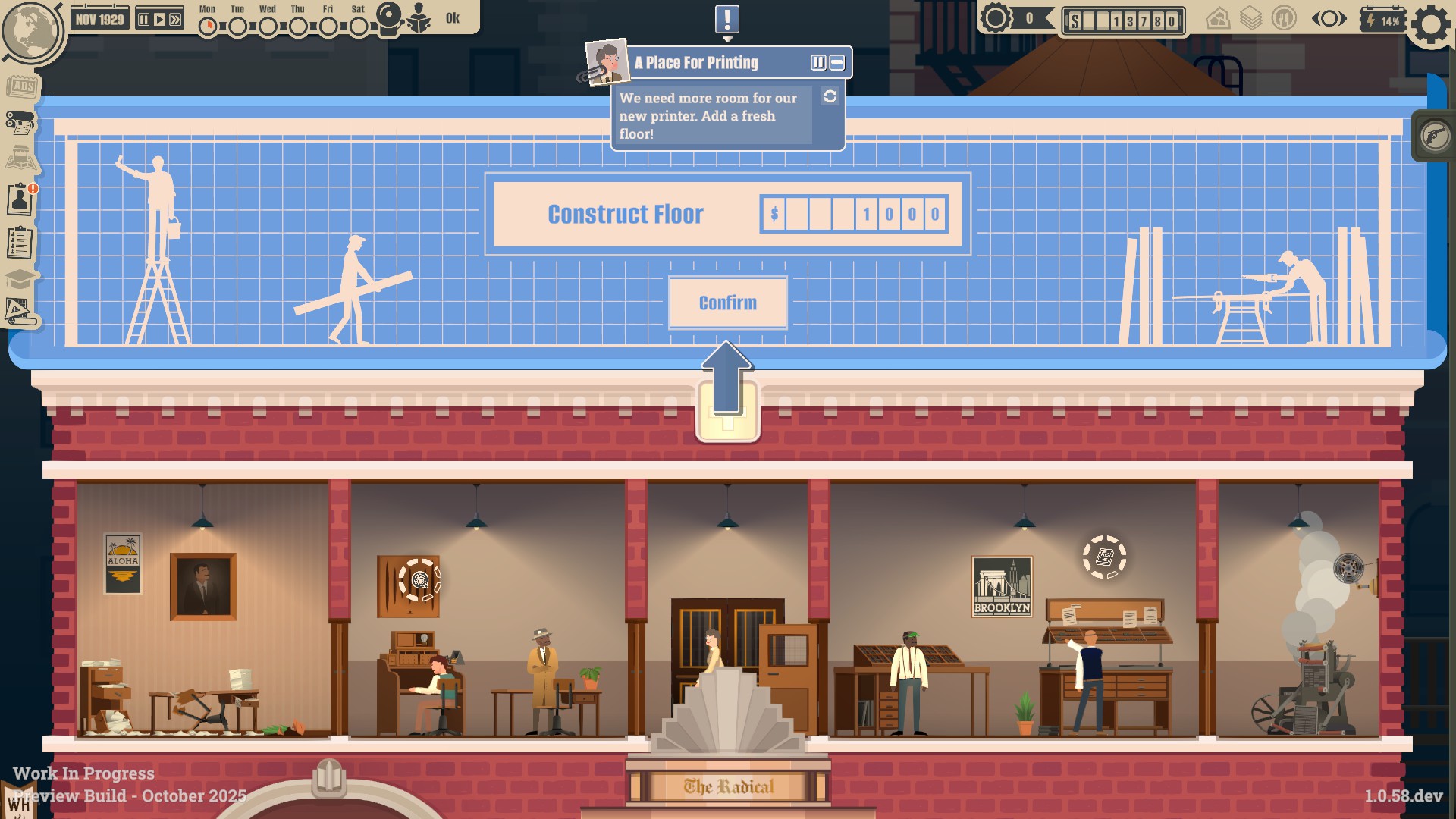
These are generally what we have to do on the strategic field. On the level of daily tactics, we are concerned with the gradual development of the newspaper's headquarters, from the bottom up, gradually adding vital space per floor. The taller the building grows, the more expensive new space becomes. On each floor, we develop the workspaces of our employees—primarily journalists and secondarily all auxiliary staff who are nevertheless necessary for the final processing of articles and the completion of the edition—with as much coherence and rational design as possible. From A-list reporters down to coal stokers for generators and janitors. Our raw material, the reports, comes from a search initially in the USA and later around the world, which we can direct according to the type of news we are looking for. When we spot the news, we send the appropriate journalists, according to the news type, to cover the event. The time it takes to cover the report depends on their experience in the field, which is important for the article to make it into the Sunday edition and to exclude competitors in case they have also sent coverage for that specific news.
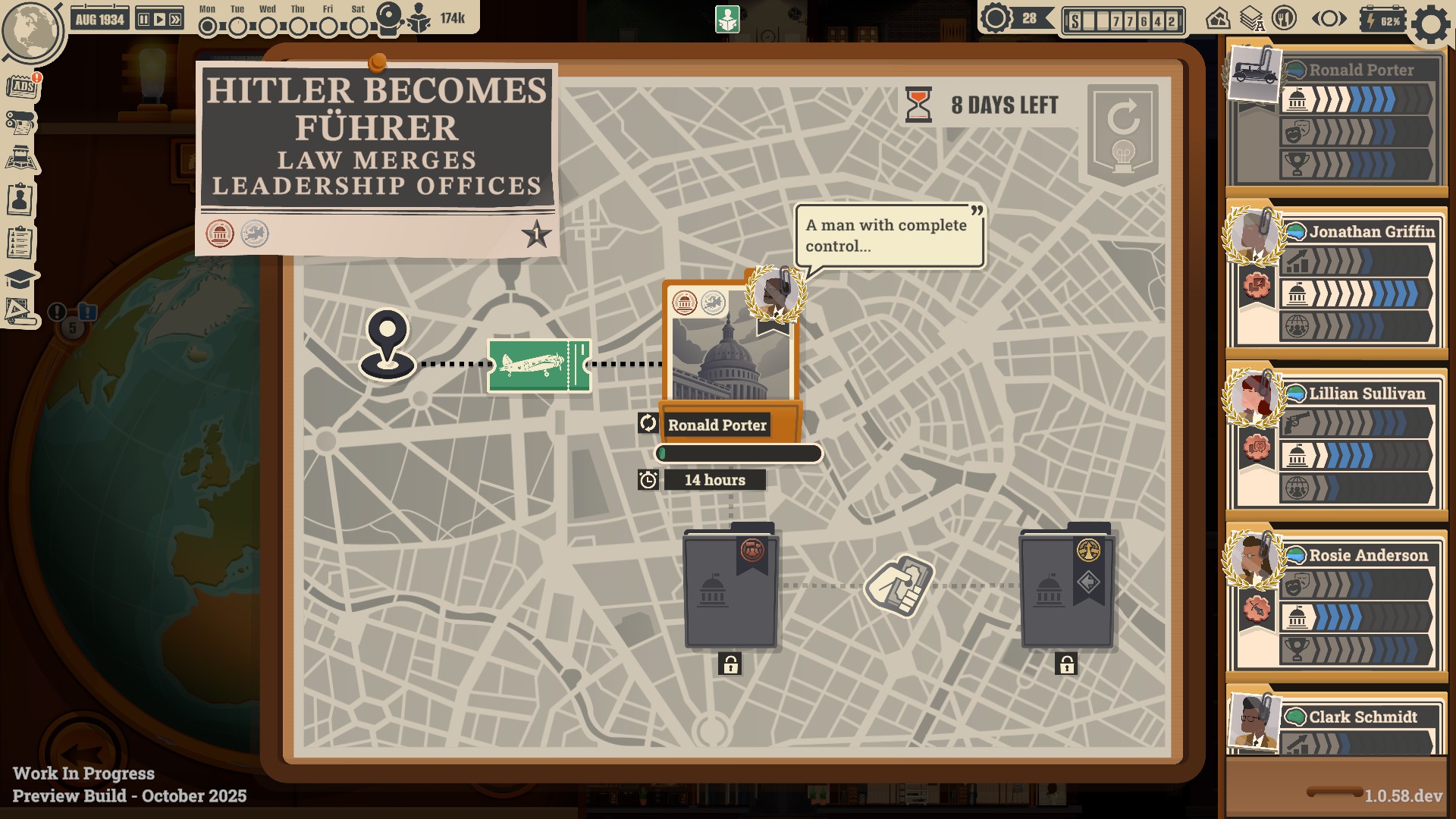
When we have accumulated a volume of finished articles in the editor-in-chief's drawer and Sunday arrives, it's time to design the front page and other pages of the newspaper. The way something is presented, the sequence, and the coherence with other news build a narrative, and when combined appropriately, they give us bonuses on the sales of the final issues but also affect the public's perception of our newspaper—whether they consider it informative and reliable or more...emotionally stimulating. Other entertaining things happen during the working days to spice up the gameplay. For example, depending on the news we cover, a visit by thugs to the offices or a protest outside the headquarters may occur. For the correct handling of such predicaments, the aforementioned special items are needed, which we can buy with influence points from the appropriate spots in the city. Through these mechanisms, there is always a sense of purpose, and the gameplay avoids stagnation, at least to a large extent, as there is a constant feeling of evolution and progress.
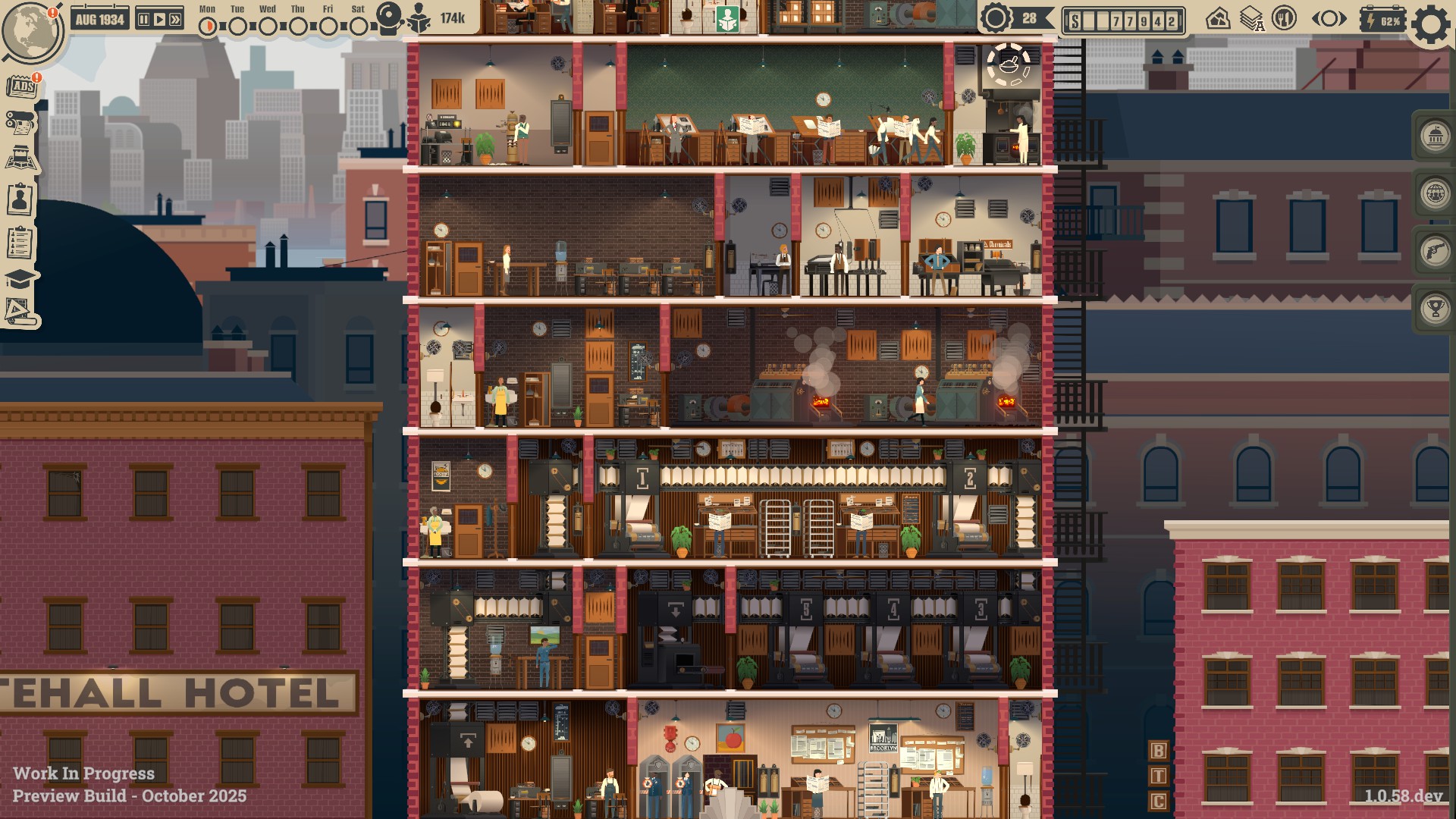
Among the game's great strengths, as a clear indication of quality and love during its creation, is the atmosphere. The exceptional Jazz/Jazz Swing tracks are convincing for the trip to the era, although there is a small repetition on the results screen at the end of each week. However, during the main gameplay in the building, the music really works beautifully and immerses one in the feeling of the modern era. The visual part is equally well-cared for. The chosen aesthetic is that of slightly comic figures for the tower staff, with very well-maintained props and colour palettes consistent with the era. Everything is convincing in the details: the bathroom tiles, the bricks of the internal corridors, the wallpapers, the Art Deco details on metal elements, the vehicles circulating in the city, and the line of skyscrapers on the horizon. Personally, I found it very relaxing just watching my tower staff moving in the building's 2D cross-section, producing the next edition. Another nice element is that the news that emerges is relevant to the date and global developments and gives a sense of careful writing rather than randomly generated text, although gradually, as the volume of daily work increases, the player tends not to pay particular attention to the news itself but mainly to look for the topic and the angles sought for the target audience of the next edition. Thus, by the late game, the focus has shifted from the news itself to issues of managing the production line of our skyscraper.
In conclusion, I found News Tower to be imbued with the spirit of old Tycoon games, perhaps only a tone easier than their traditional hardcore nature. But even in this case, the possibility of challenges with very narrow or very wide towers is provided. There is a small repetitiveness from a certain point onwards, but overall I think it can sustain two playthroughs (over 20 hours) of great fun, which I consider very honest for the game's price of 25 euros. I believe that the Sparrow Night team is driven by passion for the Tycoon genre, ran a very fair Early Access, and I truly look forward to their next expansions for the title or their next proposal. I wholeheartedly recommend it to lovers of Tycoon games and the interwar aesthetic.
RATING - 85%
85%
HOT OFF THE PRESS
A thoroughly honest Tycoon game with great fidelity to its roots and exceptional care for the 1930s aesthetic. It doesn't redefine the genre, but if you're looking for a vertical sim with a strong theme, it's absolutely the right fit.