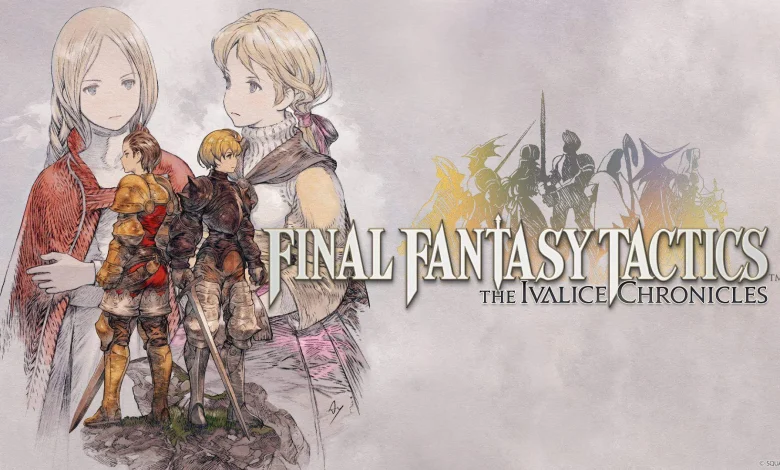

The legacy of the game we are presenting today has taken on almost mythical proportions among Final Fantasy fans and console gamers in general. It is considered one of the best tactics games of all time and possibly the best Final Fantasy game, even though it does not fully belong to the jRPG genre that the rest of the franchise's games fall into. So today is an opportunity to answer two crucial questions: First, can a game that was first released way back in 1997 still hold its own today? And second, is it really one of the best tactics games or is it just great "for a console game"?

The plot of Final Fantasy Tactics – The Ivalice Chronicles (FFT in short) takes us to the fantasy kingdom of Ivalice which is in turmoil by a dispute over the succession to the throne following the death of the king. The war between the rival parties is tormenting the people and drags our protagonist Ramza, scion of the renowned Beoulves family, into a labyrinthine conspiracy that will make him persona non grata to the warring factions, the church and mysterious factions and dark forces operating behind the scenes with their own nefarious motives. The plot and dialogues of FFT are widely considered one of the game's strong points and rightly so, as the developments are often fast-paced and the twists and turns are numerous, while the main characters have surprising depth for a 1997 console game. However, I think the game has a similar problem to the one I commented on in my review of Triangle Strategy, a game that was clearly the spiritual successor to FFT: Especially in the early hours of the campaign, the dialogues mention so many names of people and factions that it takes quite an effort (and frequent reference to the relevant help section in the menus that summarizes the developments) to be able to follow the story without getting lost.

The gameplay loop can be summarized as follows: Move around the game map between different locations on your way to the next campaign objective and engage in turn-based battles when the plot requires it or if you happen across a random encounter. In cities you can also buy and sell equipment, recruit new units to add to your team and perform some additional actions depending on the location. One strange thing I noticed is that the game allows you to have up to fifty units on your team roster but I found no reason to have more than 7-8, since most battles have a maximum limit of five units that you can field. I imagine that some players may want to have a deep roster with all kinds of classes (or Jobs as they are called in the game), but it is so easy to change classes at any time that it seems unnecessary to me, given that the units in reserve should be used regularly so that they don't fall behind in levels.


I would describe the combat system as classic turn-based, in line with jRPGs, with the order of play determined by the initiative bar and each unit having a range of possible actions available to it each turn: attack, special abilities, wait, you know the drill. The main difference with most jRPGs and what makes Final Fantasy Tactics more of a strategy game and less of a jRPG is that the units are not static but move freely on the battlefield. The positioning of units is quite important, given that the maps are small in size but have various vantage points (high points that favor ranged units and casters) and choke points (narrow points that are ideal for blocking with melee units in the style of Leonidas at Thermopylae). There are also various other factors that affect unit performance such as physical/elemental weaknesses, terrain, weather, and even... zodiac signs! At first glance combat seems fairly simple but it has some hidden depth for enthusiasts who want to delve into all the systems provided. Unfortunately, in several battles, you will have an unexpected enemy: the camera! The game does not have a free cam but only supports four specific viewing angles, which means that in many cases you will not have the visibility you should. There is an overhead view by holding down a button but you cannot give commands from this angle.


By far the most interesting element of combat, however, is the Job system and the way it affects units. Jobs are the equivalent of classes in other RPGs and choosing a job gives each unit bonuses to basic attributes as well as access to powerful special abilities. The unique feature of the system used in Final Fantasy Tactics is that on one hand you can change jobs at any time outside of battle and on the other hand each unit can use characteristics from all the jobs it has unlocked at the player's discretion, resulting in the ability to create powerful hybrid classes with elements from 4-5 different jobs. The whole system is very flexible and encourages experimentation and the creation of completely unconventional classes that add an extra dimension to the gameplay. Do you want your Knight to also have the White Mage's spells to heal himself and others? You can. Want your Black Mage to wear the Dragoon's heavy armor for better survivability? You got it. Want your Ninja to have the Chemist's auto potion ability to automatically heal when taking damage? You got it. Want your thief to have the Monk's First Strike ability to attack first when targeted? You got it!

This free mixing of jobs and abilities to create new classes is so interesting that at one point I found myself grinding through random encounters solely to unlock new jobs and abilities and try out new combinations I hadn't imagined. The job system also proved to be a valuable ally in some of the campaign battles that proved particularly difficult for my regular party. A little tweaking of abilities and equipment was enough to more effectively meet the specific requirements of those battles and ultimately emerge victorious. In fact, because there are so many jobs and abilities available that it's unlikely you'll see them all in one playthrough without endless grinding, there's also the factor of replayability. I would definitely like to replay the campaign on Hard (Tactician) at some point in the future and minmax all the jobs.

For my overall assessment of Final Fantasy Tactics – The Ivalice Chronicles, I found it particularly useful to compare it with Triangle Strategy, a game clearly inspired by FFT. I would say that the purely tactical part of Triangle Strategy was somewhat deeper, and the same applies to the role-playing factor due to the element of decision-making at key points. However, Final Fantasy Tactics has the great advantage of the Job system which adds depth and replayability and I think the plot and writing are better than in Triangle Strategy. Ultimately I think both games are very worthwhile purchases for those looking for a "light" tactical game with a taste of jRPG, but I would give a slight edge to Final Fantasy Tactics because I never felt tired at any point, unlike Triangle Strategy, which did tire me out at some point with its extended chatter. Nevertheless, both of Square Enix's games are of high quality and I recommend buying them.


Thanks to CD Media for providing the review code.
RATING - 87%
87%
A relatively light but high-quality tactics game with an original job system that still remains fresh many years since the original release.