Simon first appeared way back in 1993, at a time when the huge success of Secret of Monkey Island and point-and-click adventures in general prompted many creators to try and get their share of the pie. The brainchild of British creator Simon Woodroffe, Simon the Sorcerer, unlike the more "American" Monkey Island, was clearly influenced by the British school, both in its setting, which was very reminiscent of Terry Pratchett's Discworld, and in its dry humor and intense satire of the fantasy element.
Although the first two Simon the Sorcerer games were reasonably successful, the series never achieved the status of the "rival to the throne," while the unfortunate decision to transfer the third part to 3D led to Woodroffe discontinuing further development of the series. Nevertheless, a few years later, Simon's adventures continued with two adventures of dubious quality, produced by the German company Silver Style Entertainment, while Simon 6 was never completed, following a failed Kickstarter campaign.

The announcement of the development of Simon the Sorcerer: Origins was somewhat unexpected but welcome, yet it was met with some skepticism. On the one hand, because once again the development is changing hands (Simon Woodroffe has no connection with the project here either) and is being transferred to the Italian Smallthing Studios, and on the other hand, there was a significant delay in its release after the initial announcement, to the point where we believed that this Simon would also end up forgotten. Fortunately, this did not happen, and Simon the Sorcerer: Origins is now a reality. You will find out right away whether it was worth the wait.
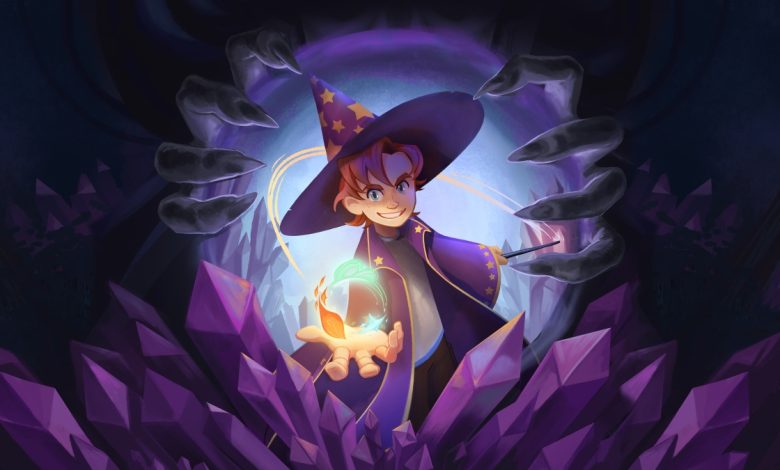
As the subtitle of the new Simon clearly suggests, Origins is a prequel and takes us back to shortly before the events of the original game. In the fateful year of 1993, Simon and his family have just moved into their new home, a decision with which our protagonist strongly disagrees. As his parents unload their belongings from the car, Simon begins to explore the house until, while trying to open the door to what is supposed to be his room, he is transported through a portal to another, fantasy world. Admittedly, it is a strange world, full of monsters of all kinds, which, paradoxically, speak his language, wizards, some powerful, some... not so much, and, of course, infinite magic.

The truth is that Simon is not particularly enthusiastic about his new situation, and his primary concern is to find a way to return to his "normal" life. This is no easy task, because no one knows how to do this, and his first meeting with the famous wizard Calypso, who could theoretically solve his problem, led to a dead end. Well, almost, because according to a prophecy, Simon is somehow the "chosen one" who will be able to learn more about the First Wizard, the mysterious wizard who brought magic to the world, and about his two lost tomes, which, among other things, will surely contain the answer to Simon's return to his own dimension. But in the search for the two tomes, Sordid, a very powerful teacher from the academy of wizards (alas, is there no school for apprentice wizards?), is deeply involved, and he has no intention of using the First Wizard's knowledge to create a better world...
As you can imagine, Simon's main mission is to locate the two tomes so that he can return home, while during his adventure he will discover that almost no wizard has realized the danger posed by Sordid, as they are all too busy sleeping and enjoying themselves. Of course, we watch all this with a strong sense of humor, as the game does not take itself seriously (as has always been the case), while it goes without saying that it satirizes everything related to contemporary pop culture and, above all, Harry Potter.

The humor, however, is hit-and-miss, with some inspired moments and fluctuating on the same wavelength as the first two Simon films, but not reaching the same level of "farce." Besides, it's a bit difficult for that to happen these days, due to political correctness, but that's a big debate that is not relevant here. What is certain is that the cheerful atmosphere of Origins is successful, without becoming corny or forcing laughter – and the breaking of the fourth wall, with Simon addressing the player, is "just enough" so as not to become excessive.
As for the main game, Origins is a classic point-and-click adventure, with no elements that stray from the beloved formula. It has most of the features we find in modern versions of the genre, such as a hot-spot indicator, quick access to the inventory, a to-do list, fast travel (somewhat limited, but functional), double-clicking to make Simon walk faster, and so on. In terms of controls, we have no complaints; Smallthing Studios has incorporated all the quality-of-life features that a self-respecting adventure game should have.

We will dwell a little longer on the puzzles. In general, the puzzles are reasonable, always in line with the fantasy setting of the game, and there are plenty of them in terms of number, variety, and density. When we gain the ability to use certain spells (fire, ice, air), the ingenuity of the puzzles begins to expand. We would say that at almost every step Simon takes, we have to face a problem that, most of the time, we are aware of and there are some clues as to how to proceed.
However, there are some glaring cases where the lack of a hint is so pronounced that it can cause us to wander around aimlessly for a long time, creating a feeling of discontent. For example, in one of the puzzles we have to solve to obtain a spell, we have to read a book to decipher some mumbo jumbo. For some reason, right-clicking on the inventory is not enough (Simon simply comments that he does not like reading), but we have to use the book on Simon for him to study it.

Let's say that this is an oversight on the part of the reviewer (that's me). Below, there are a couple more instances where Simon's response to some of them, when we click on the relevant hotspot, indirectly directs the player to think of something else, while the solution is right where Simon suggests we ignore it! We don't want to give away any spoilers, but in such cases, it would be preferable to have some other kind of guidance. Not by giving us the solution on a plate, of course, but at least by framing the way we should move forward rather than preventing us from doing so. Something similar happens with the addition of the magic hats.
Magic hats are a clever gimmick in Origins, which mainly change the properties of certain items in your inventory when you wear them. With this in mind, we can solve certain puzzles that require, for example, a specific ingredient that is not found anywhere else in the game. Admittedly, it's a nice idea that, although it doesn't evolve spectacularly during the adventure, has been beautifully integrated into the game's mechanics. However, when some plaques appear later in various locations in the game, even though a "tutorial-type" pop-up appears, it does not emphasize enough how important it is to "decipher" them in order to obtain the magic hats. Essentially, nowhere is it communicated that there are additional hats as a mechanism before we acquire the first one, and the impression is given that this is all part of an optional rather than an essential process, while the tutorial appears only once and no further reference is made to the enormous importance of the plaques for the progress of the game.

As a result, it is possible for a player to get stuck for hours at the same point, with the game making no attempt to help them, while in other, clearly simpler cases, Origins gives more hints than we might need. This relatively uneven distribution of difficulty is our biggest complaint about the game, as it feels a little "unfair" to the player, trying to make them get inside the creators' minds in a clumsy way, when it could have maintained the same level of difficulty without resorting to the dubious solution of "here's the puzzle, guess what you have to do and in what order."
Beyond this issue with Origins, which we believe can be fixed with an update, the rest of the game is quite enjoyable to play. It has just the right amount of mystery to keep you interested until the end of the game, there are various Easter eggs for fans of the original games, and the atmosphere is spot on, adopting Simon's familiar, "cheeky" style within a deliberately typical fantasy setting. However, we weren't blown away by the plot and ending of the game, which is merely pleasant and, compared to other adventures we've played this year, is clearly less impressive.

Now, as for Origins' graphics, the game adopts an art style that may not be for everyone, but it certainly stands out and has been carefully crafted by the artists at Smallthing Studios. A peculiar combination of cartoon aesthetics and pastel colors, as if hand-painted, works well in some cases, while in others it simply goes unnoticed, although this is clearly a matter of personal taste. As for the audio, one definite positive is the return of Chris Barrie as Simon, with no other actors lagging behind, while the melodic soundtrack by Fisher/Maioli beautifully accompanies the action without being overbearing. A surprise is the addition of Rick Astley's famous 80s hit "Together Forever" to the game's credits, although lyrically we can't find any particular connection to Simon the Sorcerer. Oh well.
In short, Simon the Sorcerer: Origins is an adventure game aimed primarily at fans of adventure games and the series in general, and we would not recommend it to someone new to the genre, due to the way the puzzles are implemented, as mentioned above. It will not change Simon's status in the adventure world, but it is a fine addition to the series, which respects the material it is called upon to manage.


RATING - 73%
73%
Wizard's dream
A welcome prequel to a series of adventures that caused a sensation in the '90s, but which, taken as a whole, is not particularly impressive.