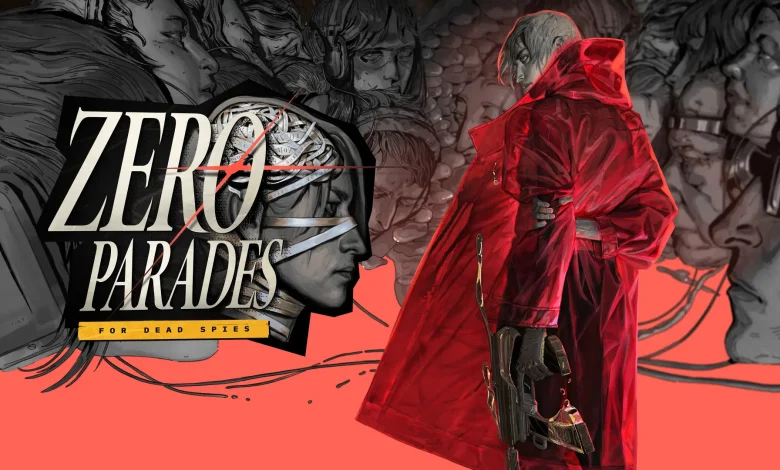

I’d say that Zero Parades by ZA/UM is practically a cursed game by default. From a purely gaming perspective, it’s cursed because it was developed by a company whose previous game may be is one of the greatest games in the history of the medium, a fact that will inevitably lead to constant references and comparisons against which, rightly or wrongly, the second game will always end up appearing as the inferior product. On a broader, “corporate” level, it is doomed due to the unthinkable chaos that has prevailed, and to a greater or lesser extent continues to prevail, inside ZA/UM over the past four years. A chaos that itself resembles some kind of meta-ironic plotline we might experience in a ZA/UM game, and which will inevitably cast a heavy shadow over anything the company undertakes or will undertake in the future.
This turmoil is, of course, significant because it also had a decisive impact on the development process itself. Following the departure of the company’s three “big” creative minds, any plans that had been set in motion for a direct sequel to Disco Elysium were scrapped, and ZA/UM shifted toward creating a title that feels more like a spiritual successor or one “inspired by Disco Elysium” rather than a sequel. Or at least, one that tries, admittedly very hard, to come across as such a title.
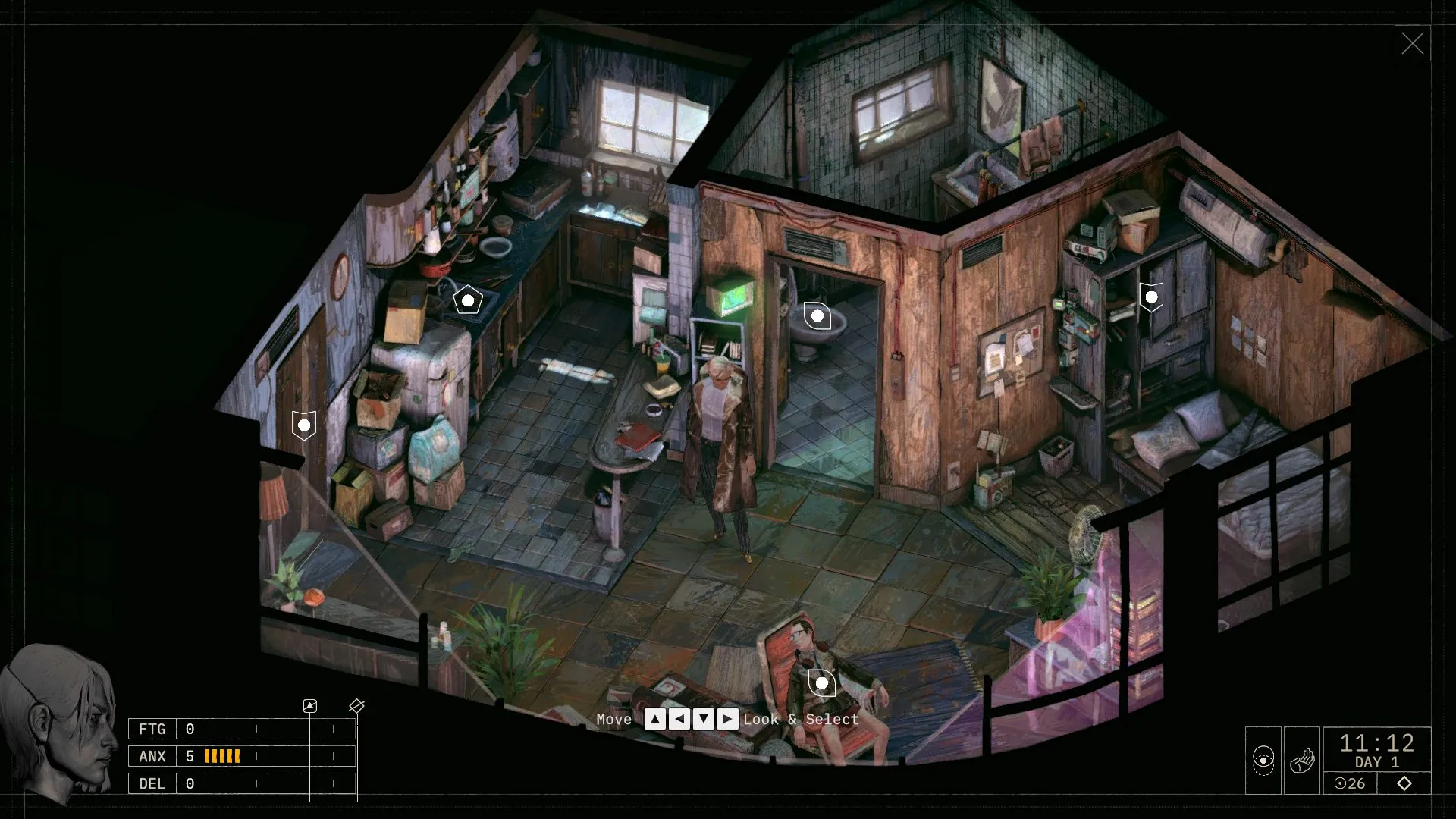
Zero Parades takes place in a completely new universe, which, of course, attempts to draw clear inspiration from the world of Disco Elysium. The main elements are pretty similar: nations and city-states with different political systems, a turbulent past as well as an uncertain future, capitalists, communists, democrats, liberals, imperialists, dictators who were both loved and hated, and large multinational corporations fighting with both legitimate and illegitimate (mostly illegitimate) means to secure their interests.
There are two main new elements that ZP introduces into the above cocktail. First, the rather interesting concept of “cultural imperialism,” in which the world’s leading imperialist superpower attempts to impose its influence on its neighbors through the use of seemingly innocent means such as music and movies. On the other hand, there are secret services and intelligence agencies fighting behind the scenes to promote the interests and way of life of the state and ideology they support.
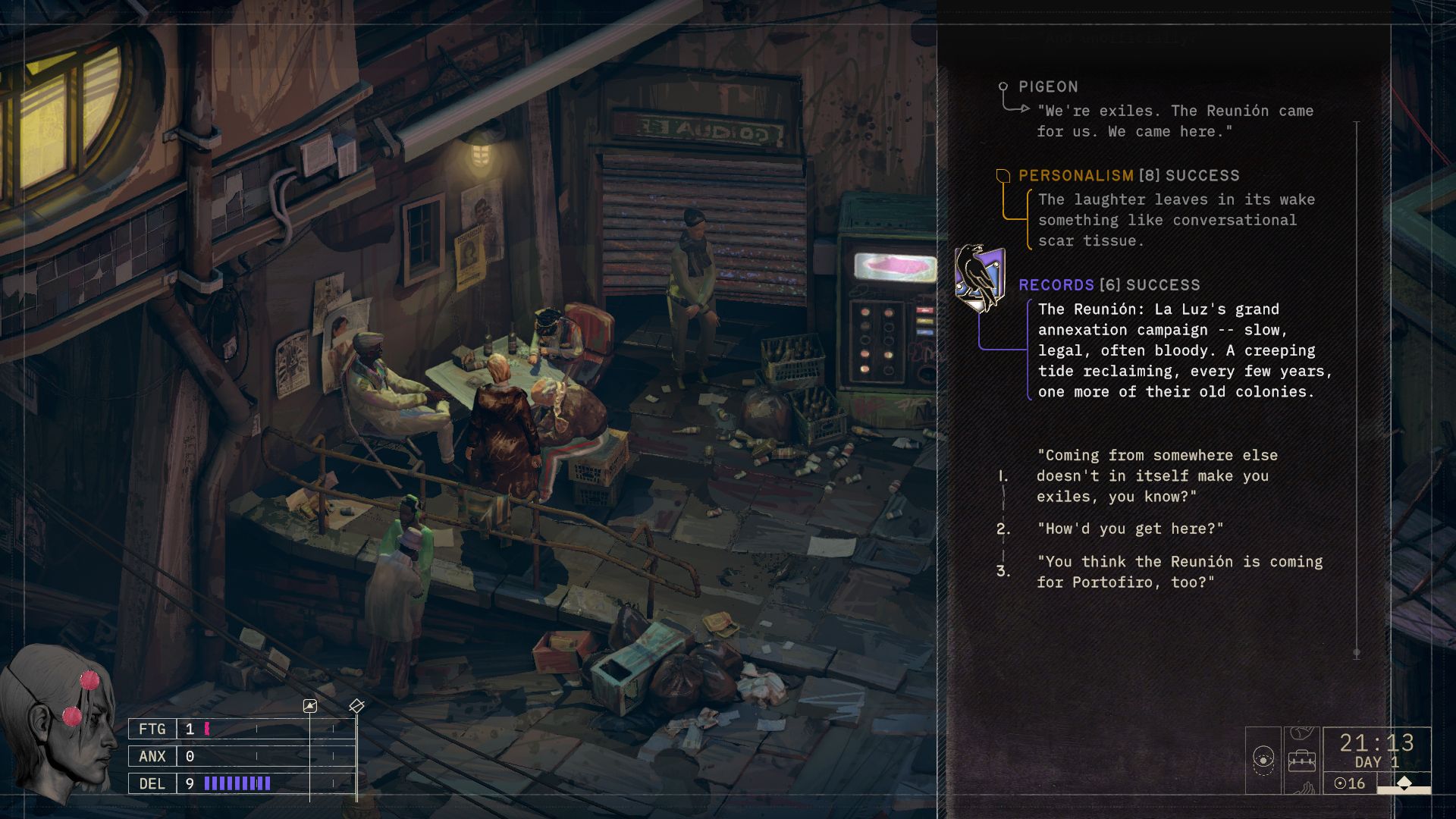
ZP's protagonist is one such secret agent, working for Opera, the secret service that promotes the interests of the Superbloc (the game's equivalent of the USSR). Hershel Wilk, codename CASCADE, had been one of Opera’s most capable agents for many years, and the team of agents she led operated successfully in the island city-state of Portofiro. Until, as always happens, something went wrong: the identities of her team members were leaked to a rival intelligence agency, and CASCADE was the only member of the crew who managed to leave Portofiro in time.
As punishment for this disaster, Opera grounded CASCADE in a thankless desk job for five consecutive years… until the time came for her to be called back into action. She is ordered to return to Portofiro and meet with another agent, codename PSEUDOPOD, to receive her orders. From the very beginning, however, CASCADE’s return is anything but triumphant. Upon entering Opera’s safehouse in Portofiro, she discovers that PSEUDOPOD is, for some reason, completely catatonic and unresponsive to his surroundings. And that’s how our adventure begins.
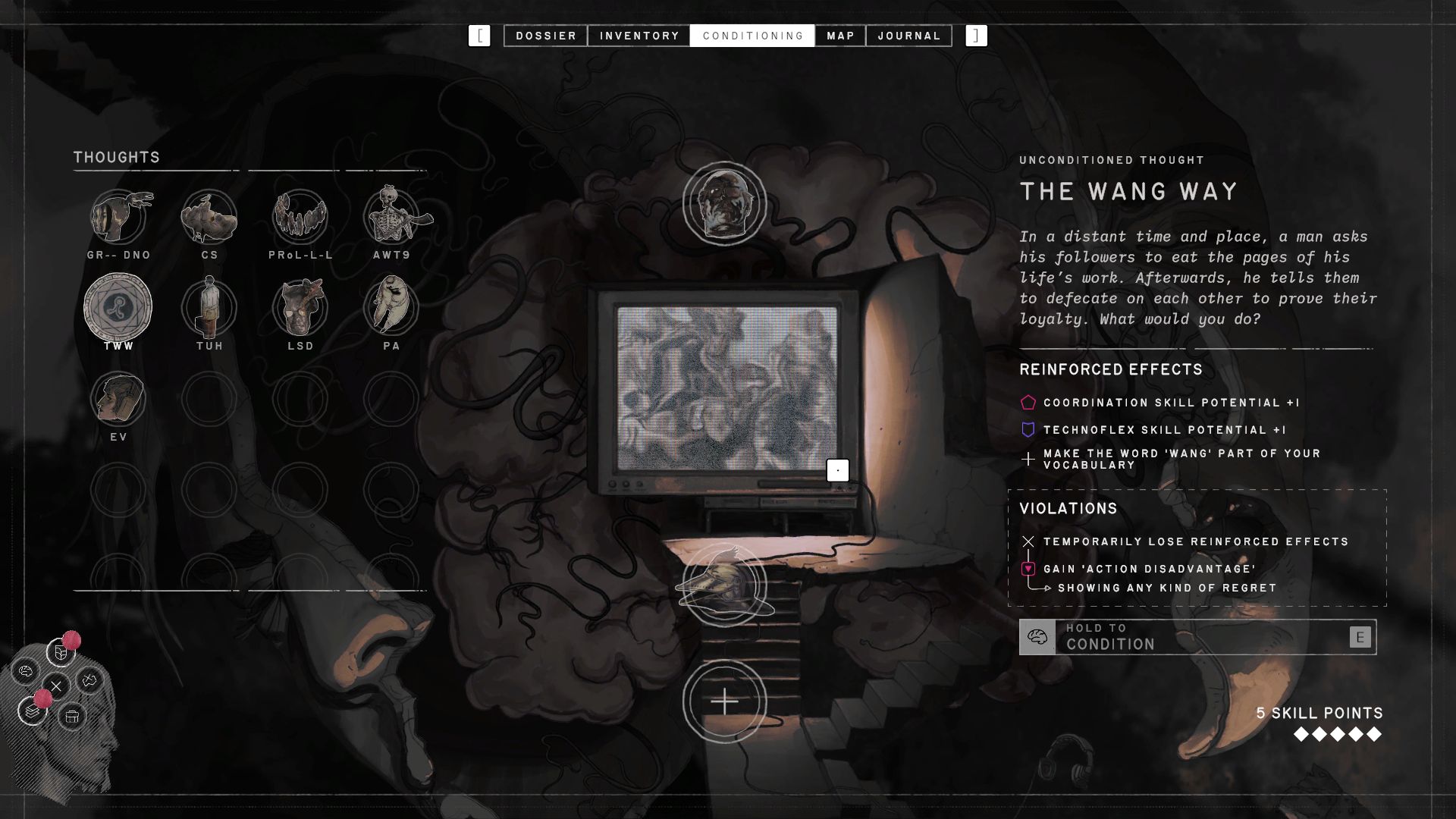
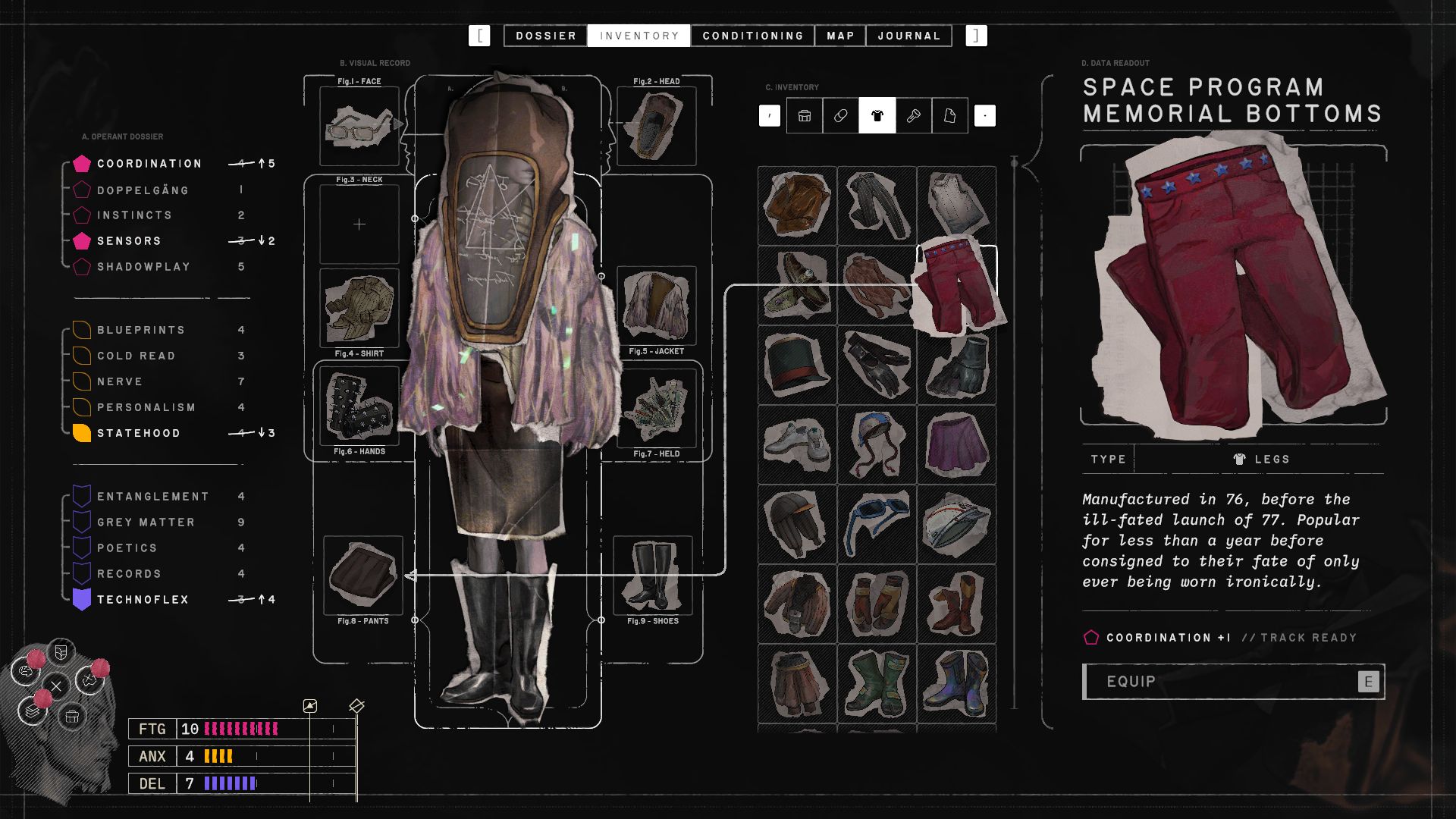
Anyone who has played Disco Elysium will immediately recognize some familiar features in Zero Parades. The first of these is the art style, which largely follows the style established in DE, but even when it attempts to differentiate itself, it does so in a way that doesn’t hide its roots or original inspiration. The second is DE’s distinctive skill system, which follows exactly the same principles here regarding the allocation of skill points, gaining new ones for every 100 XP earned, and their use in dialogues and the game world, but with a significant “literary” difference. Unlike in DE, where the various skills corresponded to aspects of the protagonist’s turbulent and schizophrenic temperament, in ZP the skills correspond to aspects of CASCADE’s espionage training.
It is worth noting that ZP has fewer skills than DE (15 versus 24), and they are grouped into 3 categories, compared to DE’s 4. It’s also worth noting that the DE’s theme of “even failure leads to something new, fun, or unique” is also present in ZP… but not entirely. During my playthrough, I encountered skill checks where failure had some pretty funny results that still advanced the plot, but there were also quite a few others where failure blocked potential paths forward or simply resulted in gathering less information during a quest.
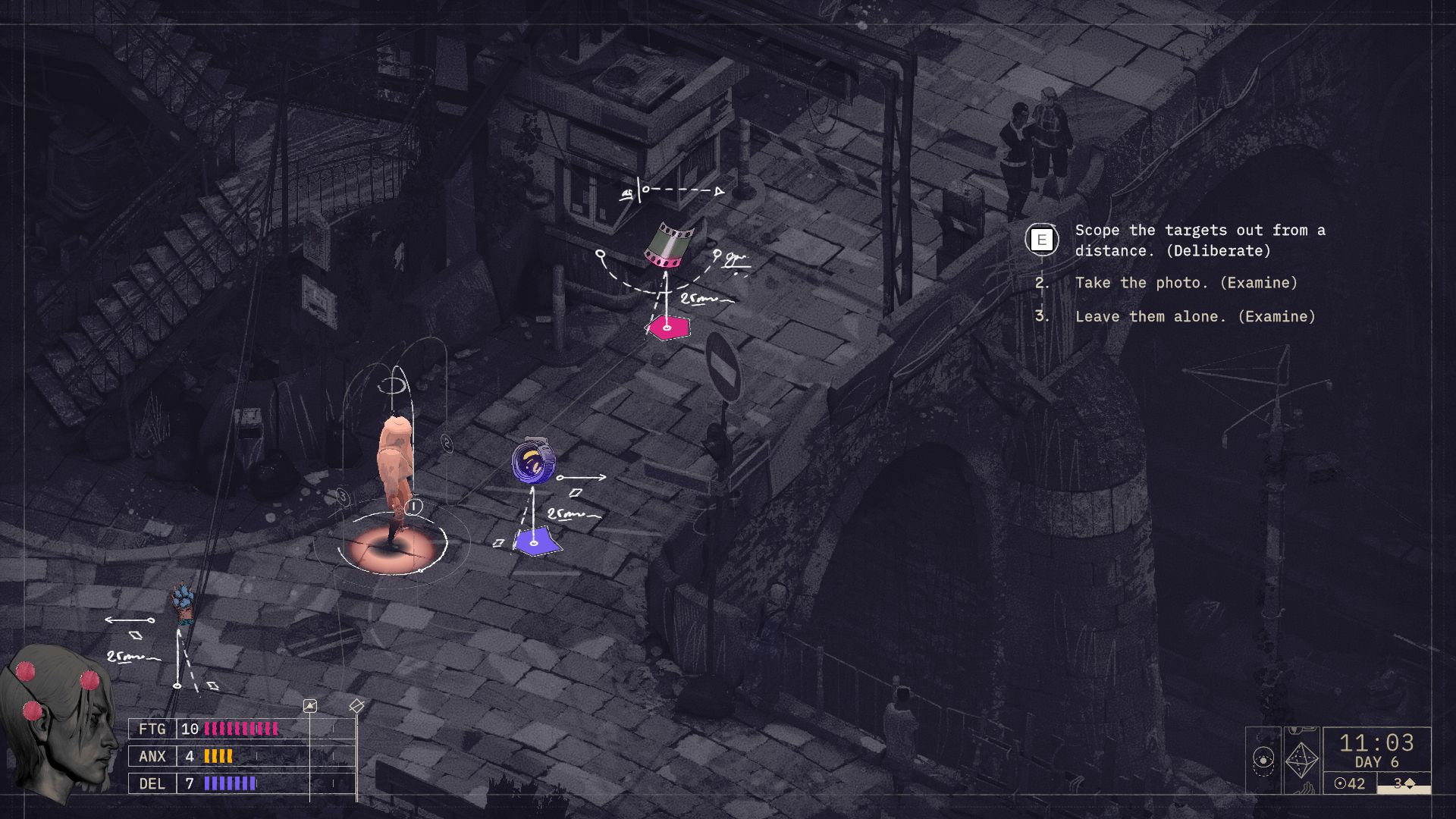
There are differences in the number and function of health meters. DE’s Health and Morale stats are replaced by three new stats: Fatigue, Anxiety, and Delirium. These fluctuate during dialogues, through substance use (something that we are pretty much obliged to do in order to balance these meters, unlike in DE where you could complete a fully “sober” playthrough), or by sleeping at the safehouse. These stats are set to zero by default, and if any of them rise unchecked without being reduced in time and end up reaching the maximum, then you must “sacrifice” a skill point from some skill to reset the meter to zero.
Another difference from DE, which may well please quite a few people, is the fact that there is no clear time limit in terms of days within which we must complete our main mission. There is, of course, a “point of no return” in the plot, where X NPC will bluntly tell us “finish up your business because after this we’re moving on to the endgame,” but we can reach that point at our own pace, no matter how many in-game days pass. Although the truth is that 8-9 in-game days are usually more than enough for anyone to complete all the game’s available quests.
Overall, Zero Parades is a much more down-to-earth and “gamey” game compared to Disco Elysium, both in terms of the project’s overall scope and its individual gameplay mechanics, as well as its writing. So I’d say that if someone is looking exclusively for the gameplay style of Disco Elysium, and maybe the art style, too, and nothing else, then they might very well have a great time with Zero Parades. Despite its turbulent development circumstances, and setting aside the sociopolitical implications stemming from this turbulence at the corporate level, the game certainly has its moments, the world has its interesting touches, there are some memorable NPCs, and certain mutually exclusive branching paths that partially determine the world state in the story's (in my opinion, rather unsatisfying) finale after about 20–25 hours of play.
BUT, the curse I mentioned in the introduction inevitably comes to the fore. If anyone has even the slightest appreciation for the literary, sociopolitical, and psychological dimensions of DE, they will inevitably feel, from the very beginning to the very end of their experience with ZP, that they’re dealing with a game that’s a total “tryhard”. The developers tried WAY TOO HARD to emulate the Disco experience, the world-building, the humor, the “surreal” scenes, the tormented protagonist, but EVERY aspect, one by one, feels lacking compared to DE. At best, the player ends up thinking, “well, at least the guys tried,” and at worst, it triggers an almost uncanny valley effect, where the player feels like they’re playing a game that’s trying to be like Disco Elysium, but their brain can sense that something’s off, and this creates an inexplicably uncomfortable feeling in the soul.
Oh, speaking of tryhards, I feel compelled to mention the game’s full-voiced narrator, whose vocal tone is DREADFUL. Seriously, I haven’t heard a more pretentious and contrived voice in all the years I can remember playing games. THANKFULLY, the menu offers the option to turn her voice off completely, which is exactly what I did within the first 5 picoseconds of playing the game.
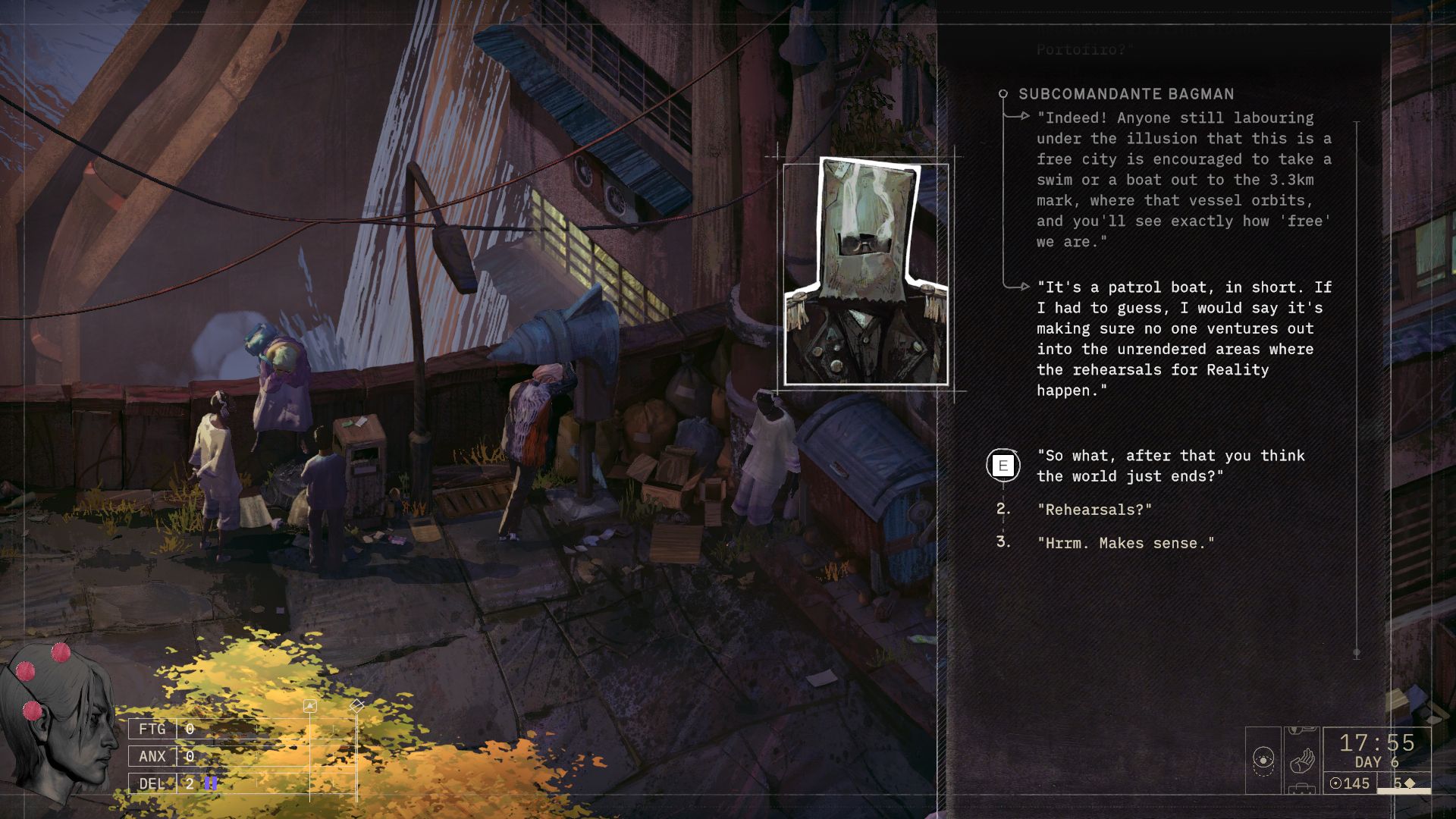
To put it more simply, at its core, Zero Parades is "just" a spy RPG (with CASCADE being a real sorry excuse of a spy to be honest, but that’s another matter) that implements and, in certain areas, evolves the gameplay of Disco Elysium. But it’s immediately obvious that it’s missing that “spice.” Despite the developers’ best efforts, it lacks, at every turn, the dark melancholy and sense of sociopolitical decline found in DE (or at least, it attempts to capture it but doesn’t quite succeed), it lacks its humor (or at least, it tries to have it, but doesn’t quite pull it off), it lacks the metaphysical dimension (or at least, it tries to have it but… you get the point), it lacks the atmosphere, and it lacks that indefinable cosmic force that compels a man to confront his past mistakes and sins. And OBVIOUSLY, it lacks the crucial factor of Harrier “Harry” Du Bois, who walks “through pity and fear” as in ancient Greek tragedies, in order to reach his own personal catharsis, and, through that, our own catharsis as players.
As things stand, given the aforementioned corporate turmoil, it might be best for the talented people who remain at ZA/ UM to try to escape the giant shadow of DE by creating a game entirely their own, one that doesn’t try to follow in the giant’s footsteps, and thus won’t inevitably be directly compared to it. But I understand that Zero Parades, in its current form, is a cursed game, yet at the same time a game that “had” to be released for many and various corporate reasons. Oh well, what can you do. We will always have Paris Revachol.
RATING - 74%
74%
Zero Elysium
A cursed game born in the midst of a corporate whirlwind, which certainly has its moments, but which is also doomed to be forever compared to Disco Elysium and found lacking.