
The case of Pragmata is one of those that makes you wonder whether Capcom has “a lucky charm” or if it simply knows exactly what it’s doing. Most likely, both are true. From its first announcement, about six years ago, the game looked like a bizarre amalgam of sci-fi, existential exploration, and gameplay that was hard to categorize—it’s no coincidence that some compared it to the works of Hideo Kojima. After a long development period, to the point where we thought it might never see the light of day, Pragmata is finally here. And thankfully, unlike what usually happens with productions that take years to develop, the result doesn’t disappoint. In fact, it manages to stand out in its own way, in a genre where the concept of “originality” is arguably a misnomer.
If there’s one thing we need to make clear, it’s that Pragmata may, at first glance, seem like a “purebred” action/shooter game (you surely noticed the similarities to Dead Space), but in reality it has many more “hidden gems.” We’d go so far as to say it’s a hybrid that combines third-person shooting, puzzle-solving, a bit of platforming, and, of course, intensely cinematic storytelling—an unusual combination that, for some reason, works.

Undoubtedly, the visuals make the strongest initial impression; they are, without exaggeration, stunning (thanks to the RE Engine). The lunar base, where the vast majority of the action takes place, exudes a cold, almost sterile aesthetic reminiscent of classic sci-fi films, such as “2001: A Space Odyssey” (by no means a random example). The imposing environments feature plenty of detail and variety, while the frequent “play” with lighting and shadows constantly creates a sense of “unease” in the player that, at the next turn, something is going to go very wrong. At the same time, the game does an excellent job of “debunking” the motto “in space, no one can hear you scream," thanks to the apt voice-over (accompanied by an atmospheric soundtrack) on the one hand, and through the relationship between the two protagonists—astronaut Hugh Williams and a mysterious android in the form of a little girl, Diana—on the other.
The dynamic between them is one of the cornerstones of the Pragmata experience. Hugh, an engineer who lands at the Cradle base with his team—which is decimated by a random (?) earthquake—tries to find a way to communicate with Earth and return safe and sound. Diana, despite all her knowledge, cannot explain why the base is under lockdown by the all-powerful AI IDUS, nor why it appears abandoned by humans. However, she is determined to help Hugh, and her contribution is truly invaluable to their survival.

Overall, the game’s storyline manages to hold your interest throughout (expect around 12–14 hours for a typical playthrough), but the truth is that it doesn’t offer anything groundbreaking. The reason is that it touches rather superficially on the whole subject of AI, its application, and its consequences (timely, I can’t say), at the level of a blockbuster movie, while the plot’s outcome is rather predictable, even when it’s supposed to reveal some major twist.
Where it really shines, however, is in the way it presents the events, weaving a truly beautiful and, at times, quite moving story. The game spends a lot of time on the relationship between Hugh and Diana, which constantly evolves as they overcome increasingly “tough” situations. In particular, Diana’s role isn’t limited to that of a supporting NPC who leans on Hugh’s back and offers “cute” smiles and one-liners, but rather serves as a fundamental gameplay mechanic. In almost every challenge we face, we’re called upon to combine the abilities of both characters to move forward. Whether that means hacking systems and enemy robots in real time (Diana’s responsibility) or direct confrontation with weapons and dodging attacks/shots (Hugh’s responsibility). The result is something that breaks away from the stereotypes of “mindless shooting,” as the tactical aspect is strongly emphasized, combining quick thinking and reflexes.

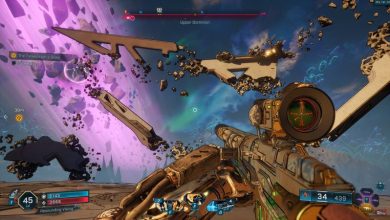
Consequently, in terms of gameplay, Pragmata takes a somewhat "heavier" approach compared to "traditional" third-person shooters. The main factor in combat is hacking: the damage caused by Hugh’s weapons is like a “caress” to enemy robots, unless they’ve been hacked by Diana. Therefore, we must first complete (in real-time, I remind you) a simple logic puzzle in the form of a grid, which varies in size and structure depending on the specific enemy we’re facing, in order to reveal its weak points and then finish it off with our weapons. Admittedly, as an idea, it sounds much more boring than it actually is. One of Pragmata’s greatest achievements is that this system manages to avoid becoming tedious, despite the constant repetition of the hacking/shooting pattern.
This is why combat is not fast-paced; but rather are tactical and intense, with each encounter requiring attention while also giving the player enough time to complete the hacking puzzles without their fingers getting “on fire.” Of course, there are several highly challenging sections with multiple simultaneous threats, where you’ll need to keep moving to avoid enemy attacks (Hugh’s thrusters do a great job of dodging) while also handling the hacking, but nothing that can’t be overcome with a little effort and practice.

From there on, the game makes sure to regularly enrich the gameplay, both in the shooting and hacking aspects, by adding new weapons and special mods to Hugh’s arsenal, as well as nodes for Diana, which “get added” to the hacking/puzzle mechanism grid and, when used, trigger buffs/debuffs that affect enemy behavior. For example, there’s the Confuse node, where, for a short time, an enemy robot “sides with us,” or the Freeze node, which (obviously) freezes its movements. Needless to say, whether we manage our equipment wisely or not can make the difference between a triumphant victory and a crushing defeat.
All of this can be found in the game’s central hub, which serves as our base for upgrading characters (shield, hacking level, skills, etc.), to complete challenges (which are also very important for further strengthening the heroes), and to return to previous checkpoints to collect items that couldn’t be obtained during our first visit (there’s a bit of a Metroidvania vibe here). It’s worth noting that every time we choose to return to the hub after activating a checkpoint, all the enemies we’ve defeated respawn. However, since the level structure is relatively linear (though with plenty of opportunities for exploration), under “normal” gameplay conditions, you won’t need to revisit any areas you’ve already cleared. But if you plan to collect everything (there are plenty of secrets—chests, logs, skill points, mods, etc.), then enemy respawn is a factor you’ll need to take seriously.

Since we’ve mentioned the enemies, it’s worth noting that there’s an impressive variety, both in number and design. You get the sense that each robot has its own personality, even though they’re essentially just twisted machines out to kill us (under IDUS’s orders), while the bosses steal the show, mainly in terms of size but also in terms of movement. You have to see them in action to believe it; the battles against them are truly epic and a blast.
If we were to identify any other drawbacks in Pragmata, beyond the limited use of the story, they mainly relate to the pace of the action. At certain points, especially toward the end of the adventure, the game drags on longer than it should, particularly when it insists on presenting similar ideas, perhaps in an attempt to extend its duration in a story that doesn’t lend itself to being stretched out any further.

Nevertheless, Pragmata is one of those games that is unquestionably worth our attention. It isn’t perfect, but it’s well-crafted with rich content; it attempts to tell a beautiful story in its own unique way, while possessing an authenticity that’s rare these days. That’s no small feat.


We would like to thank CD Media for providing the review code.
RATING - 85%
85%
Hack 'em!
Another high-quality title from Capcom, which stands out for its innovative gameplay mechanics.