
This isn't the first time a beat 'em up has been combined with roguelite mechanics. It's something we've seen before (Tunche, Double Dragon Gaiden), but it's hard to find a better implementation than the one Guard Crash Games has achieved in Absolum. This is a new IP, created by a team of talented developers who have proven themselves (they were actively involved in the excellent Streets of Rage 4), which looks set to go down in history as one of the best of its kind.
Perhaps the above prediction is a little rushed. However, from the demo that was released months ago, Absolum showed that we would be dealing with something very special, and we were not wrong. Especially when the roguelite character turns the (inevitable) repetition of beat 'em up games into an advantage, since every time we play a "run," the small or large changes that lie ahead keep our interest at a higher level than in a conventional game of this genre.

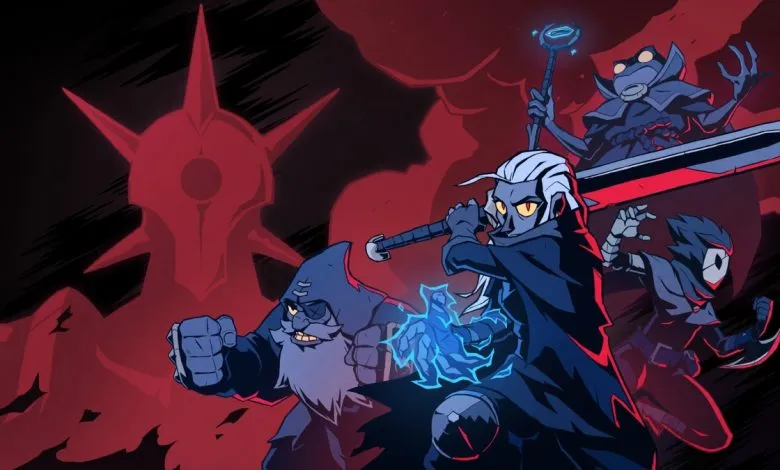
Starting with the setting, Absolum chooses to create a fantasy world, which may not be particularly original, but is well written and convincing enough to justify what we see on screen. The story includes a ruthless king, the Sun King Azra, who has banned the use of magic in the world of Talamh and is determined to crush anyone who disobeys his orders with the sword. However, a group of "wizards," Karl, Galandra, Cider, and Brome, have a different opinion and, in collaboration with a mysterious witch who has the ability to resurrect them every time they fall on the battlefield, are determined to stop Azra's authoritarian regime. Of course, all this is presented through cut scenes, narration, and dialogue (in comic book style), a result of Guard Crash Games' "love" for its creation. They don't add up to anything spectacular, but it's the little details that make the difference, as we often say.

Nevertheless, the heart of the game is not its story, but of course the unstoppable... "beating." Carrying the experience of SOR4 on its shoulders, Absolum offers similarly high-quality mechanics. With light and heavy (skill) attacks, mana-consuming spells (arcane), and the dash, which under certain conditions also functions as a block, a move that, if executed correctly, can cause enormous damage to the opponent, Absolum provides the player with the right weapons in their arsenal to create a very entertaining result. The differences between the four heroes (initially only two are available—Karl and Galandra—later Cider and Brome are unlocked) are enough to require a different approach on the battlefield. Overall, the combat system is excellent: fast, robust, and well-designed for creating huge, impressive, and effective combos, with juggling being a big hit.
However, Absolum's winning bet lies in its roguelite mechanics. As is customary in roguelites, the death of our hero is something normal and, most of the time, inevitable, as this allows us to strengthen him with permanent buffs that we "buy" in the game's central hub. However, each run differs from the previous one, apart from certain "constants" (e.g., some bosses), and our experience depends on what we "get" during the adventure. There are three categories of drops that enhance our character (only for the current run, of course): inspirations that introduce unique moves specific to each character, rituals that add an element to our moves (fire, electricity, etc.), and trinkets, which provide permanent buffs while we wear them (e.g., greater endurance).

The structure of the game is slightly reminiscent of an "arena," as on each screen we must destroy everything that moves, and once we succeed, we can then move on to the next screen, which often has two or more paths, which in turn lead to different directions and rewards. Victory in each "arena" usually comes with rewards (rituals, trinkets, upgrade crystals, or even money), where we have to choose between two or three options. What we choose is hugely important for the success of our run, as with careful choices and a little luck, it is possible to create an overpowered character that will sweep everything in its path. Of course, the opposite can also happen, with some "drops" not fitting together properly and the run quickly ending in failure – to a certain extent, because, as we said, death has multiple benefits in Absolum.
The fact that we always return to the beginning, with each run lasting up to 45 minutes, may sound somewhat tedious, but Absolum greatly reduces this feeling by offering a fairly wide variety of locations (ports, mines, plains, etc.), enemies (goblins, gnolls, skeletons, dwarves, elves, and more), side quests (yes, there are those too), and hidden passages waiting to be discovered. In general, it takes about eight hours to reach Sun King Azra, but even then, Absolum has not revealed all its cards. Certainly, it is very satisfying that even after so many hours, the game continues to show players new things, which can be enriched in the future if the development team supports it with more content (judging by the support SOR4 received, this seems very likely).

The co-op mode is another huge advantage, which works seamlessly both online and in hotseat mode. Lag is almost non-existent; specifically, I only played once with a player who had "lag," and of course, the game adjusts accordingly, both in terms of the number of enemies that appear on the screen and the endurance of the bosses. The only complaint is that it only allows the traditional "2-player option," although with more players, the situation would probably become chaotic, so we won't classify it as one of the game's negatives, which are negligible anyway.
If we want to be really strict, we would say that at a certain point, the repetition becomes quite intense, since the game requires us to reach the end in one sitting and we cannot stop to continue later. But isn't that the case with all beat 'em ups, without exception? It's the same familiar feeling of the classic titles of the genre, with the difference that in Absolum there is much more variety and it's just what you need to "unwind" after a difficult day.

Another thing that steals the show is the audiovisual aspect. The graphics and overall presentation of the game are amazing, in a similar artistic style to SOR4, with excellent colors and very smooth animation. Special mention should be made of the soundtrack, which includes compositions by names such as Gareth Coker (Ori, Halo Infinite), Yuka Kitamura (Dark Souls), and Mick Gordon (Doom Eternal), which further enhances the overall Absolum experience. An experience that is one of the best we have had in 2025 and a beat 'em up that will remain etched in the minds of fans of the genre, hoping that this is only the beginning.


RATING - 90%
90%
For Talamh!
An addictive and meticulously crafted beat 'em up/roguelite that keeps you hooked.