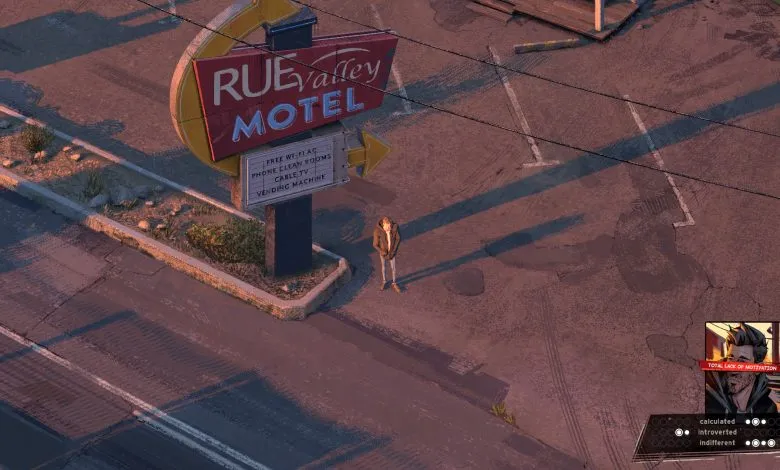

In the wake of Disco Elysium's great success and the unique way in which it managed to "gamify" the protagonist's disturbed mental state, games have begun to appear that attempt similar gameplay approaches oriented towards the psyche of the respective hero and emphasizing primarily the area of writing. To describe all these efforts, the term "Disco Clone" has emerged (something similar to "Souls-like," I suppose), which is slightly simplistic but may be necessary to describe similar games in a clear and concise manner. At first glance, therefore, Rue Valley could be described as a Disco Clone, based on what we saw of it in its initial demo at the recent Steam Next Fest. But is that really the case?

The game's protagonist is Eugene Harrow, a guy who, after suffering a nervous breakdown as a result of an unspecified incident, ended up in a small town called Rue Valley to participate in some state-mandated psychotherapy sessions. However, he quickly realizes that something is very wrong: for some mysterious reason, he seems to be trapped in a strange time loop, which forces him to constantly repeat the period between 8:00 p.m. and 8:47 p.m. on his first day in the small town. As one might imagine, Mr. Harrow's goal is to investigate the causes of the time loop and escape from it, while also struggling (mainly with himself) to resolve the issues that torment him.
In the approximately 14 hours it took me to play through Rue Valley, I would say that the game left me with mixed feelings. Some things surprised me positively, while others were disappointingly underwhelming, whether we choose to approach the game as a Disco Clone or as a standalone project with no connections or inspiration from anything else.

In terms of gameplay, Rue Valley plays more like a typical point-and-click adventure than an RPG. Any RPG element, I suppose, lies in its Disco Clone nature, meaning that the protagonist's psyche (which is partly defined by the distribution of points to certain stats at the beginning) is gamified and influences his actions within the world.
Given his burnout and depression, the protagonist exhibits a "general lack of motivation" to do anything, and must seek inspiration from the world to motivate himself. Thus, by interacting with hot spots in the world, he has the prospect of earning Inspiration Points, which he "spends" in order to transform the intentions he acquires in his "mind map" into actions (these intentions are also, in a way, the game's "quests" or puzzles—for example, one intention corresponds to finding a way to break down a door, another to stealing a plot-critical object, etc.).
Beyond that, the essence of the game boils down to making the most of the 47 minutes of each loop. Visiting locations, investigating objects, and talking to residents until we gather the necessary information and complete quests/intentions that allow us to get to the heart of the plot. Time in the game passes mainly when we travel between locations and during dialogues, not simply while exploring a location, but in any case, the management of the 47 minutes of each loop ends up being a constant puzzle that we must solve in order to do things in the game. Some characters are in one location at 8:00 and in another at 8:15, some events happen at specific times in specific places, and we have to explore everything over many loops to get all the info we can.

I emphasize the game's Adventure aspect at the expense of any RPG substance in order to point out that the plot is quite railroaded, with no real choices on our behalf. Our character's stats ultimately have little to no effect on anything, except for minor things like secondary dialogue options, which 99% of the time lead to the same outcome anyway, so there's basically no room for role-playing. The game's quests have only one outcome, the plot has only one conclusion, and the ending is the same for everyone. In general, the player's freedom within the world is relatively limited—we can travel wherever we want (depending on the time remaining before the loop resets, obviously), but the things that need to be done will ONLY happen when the developers intended them to happen. So it is entirely possible, for example, to come up with the solution to a puzzle on your own, but not be able to pursue it because the creators wanted the protagonist to go to X location first and wander around aimlessly interacting with some objects, so that afterwards he will have the scripted epiphany that he must solve the puzzle in the way you had already thought of beforehand.

Given its classification as a Disco Clone, one would assume that Rue Valley's main strength would be its writing and its "simulation" of mental disorders. But even there, things are a bit mediocre. In terms of writing, I would say the game is OK, with some flashes of charm but without being particularly impressive overall (and obviously not reaching the level of Disco Elysium), but at the same time without the writing being turbo-megacringe, a constant danger these days with writers who want to appear sophisticated and well-educated but simply end up being pretentious and edgy.
In terms of "mental simulation," both in terms of writing and gameplay implementation, the game seems somewhat lacking and even irritating at times. Beyond the lack of RP I mentioned above, and some other annoying in-game events that I won't mention so as to avoid spoilers (let's just say that at some point in the story, the protagonist is supposed to be going through a mentally difficult period and is forced to go through 7-8 consecutive loops without doing anything but choosing the same options in the dialogues – good idea maybe, but extremely annoying implementation in the game), the main issue is that the available Inspiration Points that can be acquired in the world are barely enough in relation to the intentions we can carry out. Therefore, quite often players will feel like they are "softlocked" out of the game's progression because a plot-critical intention in the Mind Map requires 2 Inspiration Points to unlock, but we have zero points to spare, so we start wandering around throughout the world for hours, interacting with everything over and over again to find the 2 Inspiration Points required to continue the plot. Once again, a pretty good idea, but mediocre implementation. Especially when combined with the fact that, as mentioned above, all intentions/quests can be resolved in only one way.

However, the biggest disappointment probably comes from the game's ending itself. I won't go into details to avoid spoilers, but in the end I can't help but feel that the ending... well, it doesn't really make sense, unless we view it purely "abstractly" or as "art that wants to be an allegory for mental health issues," which might make it even worse. It's as if the developers thought of the time loop mechanism as the core of their game, and then forced it onto a mental health story. Beyond that, however, the protagonist's role in the plot seems completely secondary in the grand scheme of things (it doesn't help that the game doesn't delve as deeply as it should into Eugene's past before he arrived in Rue Valley), to the point where I think the real protagonists of the story end up being some of the characters we interact with.

So as not to appear overly critical, let me also focus on the game's positive aspects for a bit. First of all, I really liked the visuals and sound. The stylized graphics are beautiful and very fitting, the music is excellent, and the voice acting is top-notch. Even though there is a bug in the game that essentially mutes the protagonist's voice, which has been pointed out by the developers and will be fixed soon. The story of the game itself has some pretty clever moments, except for the player's lack of influence on it and its ending, which, as I said, I have many objections to.
However, the main thing that positively surprised me about Rue Valley is the depth of its world and background lore. Its developers may have primarily wanted to tell a story about a time loop and/or mental illness, but this story was set in a location with an extremely rich in-game background. What doesn't this small town have: a pseudo-SpaceX company that plans to colonize Mars, with its own spaceport just outside the town; a mining megacorp that controls and exploits the local mines, poisoning the town's aquifer for years in the process; political tensions between the local cattle barons and the mining megacorp, which have almost led to armed conflict; relatives who mysteriously disappear; conspiracies about "signals from space." I would say that the procedural unraveling of the area's lore ended up intriguing me more than the protagonist's story itself.

And where exactly does the unravelling of all these interesting plot threads lead? Pretty much nowhere! Despite the lore that has been established, despite the clues we receive about what is happening in the area, and despite the interesting characters we meet, for the most part the player ends up experiencing all of this as mere flavor that takes place separately from and parallel to the story the developers want to tell. Too many of the interesting storylines that emerge during the exploration of the world remain unresolved at the end. It is striking (in a negative sense) that, for example, shortly before the game's ending, we encounter a character who we've learned has gone missing since early in the game, and our only interaction with this character is just a line of dialgue or two that ultimately has no impact whatsoever, nor is there any "quest" related to his disappearance. I could write a whole list of similar incidents, there are more than just one or two.
Overall, despite the extremely positive impressions left by the initial demo, I would describe the whole experience as rather uneven. I guess this is evident from the fact that even the positive aspects I mention are accompanied by a "yes, BUT...". Despite its 5-year development cycle, Rue Valley manages to give the impression that it does not fulfill all that it has the potential to fulfill, and that it is still lacking in terms of the content one would expect based on what we already encounter in the game.

Someone might say, "you see it clearly in terms of gameplay and you miss THE ARTISTIC MEANING OF THE STORY ABOUT PSYCHOLOGICAL ISSUES, you heartless moron, what matters is THE JOURNEY" and other such philosophical musings. I have already said that I believe that even if treated as a "depression simulator," the game is flawed and at times irritating despite its flashes of brilliance, but this approach may be the only one that will allow someone to appreciate Rue Valley for what it really wants to be and what it wants to achieve.
The developers have already said that they are listening to feedback and, in addition to fixing bugs, they intend to introduce extra content to the game, such as ways to further influence the ending. This is quite a positive and promising development, to be honest. Because there is something good at the core of Rue Valley, and the world the developers have created is quite rich and full of possibilities, managing, I would say, to even overshadow the main plot itself. At this stage, however, I would only recommend it unreservedly to those who are fanatically looking for a "Disco-like" game to scratch that Disco itch, those who have run out of adventure games to play, or those who want to experience it exclusively as "art" with a beautiful art style.
This review of Rue Valley was written using a code provided to us by the publisher.
RATING - 67%
67%
Underwhelming
An interesting premise with some really good ideas in an exceptionally deep and well-designed world, which ultimately feels lacking both as an adventure/RPG and as a "Disco clone."