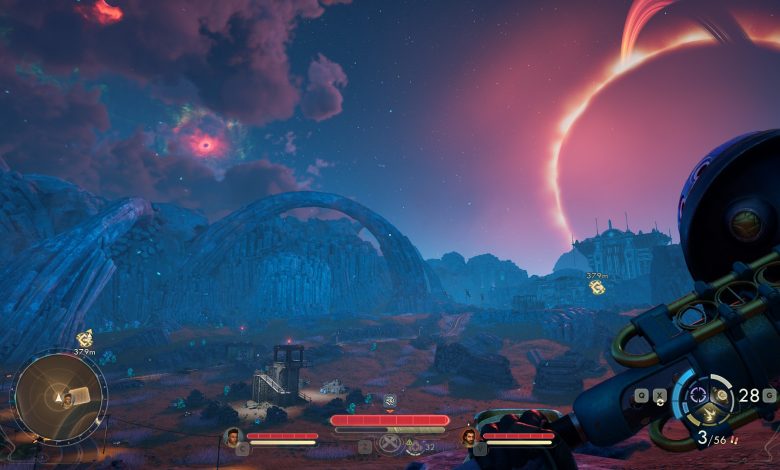

If The Outer Worlds 2 were a consumer product similar to those advertised by its in-game corporations, its slogan would probably be "now with slightly improved flavor!" or something similar. In no way is it a radical departure from the original Outer Worlds experience, but at the same time, you can't help but feel that you are playing a slightly improved version of the first game. And this improvement applies to both the design of the world and the individual gameplay mechanics.
For more details about the sci-fi, corporate dystopia that is its setting, I recommend reading our review of the first The Outer Worlds. As for the specific plot details of The Outer Worlds 2 (TOW2), to avoid spoilers about the main story, just know that we control an agent of the Earth Directorate, a body responsible for coordinating between Earth and the colonies throughout the galaxy, as well as fighting corruption and regulating relations between corporations. This agent is sent to the Arcadia system to investigate some mysterious rifts that have begun to appear there.

The fact that it takes place in a different star system than TOW's Halcyon means, among other things, that the plot of TOW2 has no connection to that of the first game, so it is not necessary to complete the first game in order to fully grasp anything that happens in the second. Of course, we see the reappearance of familiar institutions and corporations from TOW, more or less developed/diversified. For example, Auntie Cleo's has now absorbed Spacer's Choice following a hostile takeover, resulting in the creation of a new combined megabrand called Auntie's Choice.
This corporation's presence in Arcadia, and its war (literal war, not just business-wise) for expansion and dominance there, decisively affects the background of all the planets in this system, as well as our own presence there. I would even dare to say that the conflicts between Auntie Cleo's, the ruling faction of Arcadia called The Protectorate, and the technologically and scientifically oriented faction called The Order of the Ascendant, and the way these conflicts permeate every aspect of the world, are almost reminiscent of the conflict between the NCR, Legion, and Brotherhood of Steel in Fallout New Vegas. Although obviously less deep or impressive in terms of writing and in-game presentation.

Beyond the faction we choose to support (mainly between Auntie and Order, since the Protectorate is mostly a common enemy of both), TOW2 also offers a plethora of extra options in the main and side quests, which shape both the conditions of the world in each playthrough and the final state of each area in the ending. There are just as many options in the dialogues, with many of them locked behind skill checks, but also in the world, with doors, containers, or various approaches to each objective requiring points in skills such as lockpicking or hacking in order to be unlocked.
Since we're talking about skills, let me mention how they differ in TOW2 compared to the first game. The 20 or so skills in TOW, which could be increased to up to 100 (or 150 in the DLC), are now further grouped into a list of 12 skills that can be increased to 20. These groupings make sense – for example, instead of 1-handed and 2-handed skills, we have a single Melee skill, instead of Handguns and Long Guns there is a simple Guns skill, etc.

At each level-up, we earn only 2 skill points (there is also the possibility of earning extra points with the appropriate Flaws – more on them below), and the level cap at this stage is 30, so there is the possibility of maxing out 2 or 3 skills at most by the game's end. This kind of "specialization" is highly recommended if you want to pass some of the tougher skill checks throughout the game. Of course, this doesn't mean that "jack of all trades" characters who level up many skills at the same time will not be able to complete the game or anything like that, but they will likely encounter challenges towards the end which they will inevitably have to approach with fewer options.
In TOW2, the way optional Flaws work has also changed. Unlike in 1, where choosing a Flaw simply gave us 1 extra Perk Point, in 2, Flaws work more like Traits in orthodox Fallout games, meaning they offer both a bonus and a penalty. For example, one flaw increases Vendor prices by 50% but also doubles the mats that drop when we break an item during crafting. Another increases the damage we take each time we block, but also increases the damage caused by of our Melee Power Attacks.

The real highlight, however, is some extremely interesting and spicy Flaws, which can radically change the orientation of each playthrough. For example, there is a Flaw that increases the XP we receive by 15% but at the same time automatically selects random options in all dialogues! Another Flaw always selects the [Lie] options in dialogues by default, another makes our characters automatically steal items within their reach, another automatically accepts all Flaws presented to us, all with their corresponding benefits. It is clear that some of these are not recommended for the first playthrough, but would be ideal for a fun 2nd-3rd future playthrough.
At this stage, the truth is that Skills and Flaws are not particularly balanced. Some skills, such as Lockpicking, offer infinitely more in-game opportunities than others, such as Observation. An attempt is made to achieve some kind of balance through the existence of checks for most skills in dialogues, as well as the fact that all skills offer some kind of extra damage bonus in combat, but even so, the balance between skills is quite uneven (for example, the already important Speech skill also offers extra weapon damage against humanoid opponents).

The same applies to the choice of Flaws, but this could be considered a form of meta-gaming. For example, if we never buy anything from vendors but play around with crafting a lot, choosing to increase prices in exchange for more breakdown mats doesn't seem like such a bad deal. And in the end, having imbalanced and overpowered characters can certainly add to the fun sometimes.
The above main differences, combined with some other minor additions, modifications, and improvements in areas such as crafting, stealth, and combat, combine with the expected TOW gameplay to create an experience that is completely familiar to those who have played the first game (or any other first-person RPG from Obsidian, I guess), but at the same time slightly improved in all areas. The gunplay is improved, the planets and areas we visit are more memorable and well-designed in terms of navigation, quest writing and the way we can interact with the factions of the world also give the feeling of "+1" compared to TOW.

Even the implementation of Unreal Engine 5 is improved, I would say. I did encounter the characteristic, occasional stuttering and framedrops for no reason during the game, but, paradoxically, unlike what happened in other recent UE5 games such as Bloodlines 2 and Borderlands 4, most of the time I was playing TOW2, my PC case fans remained extremely quiet, even when wandering around the open world and in theoretically visually demanding scenes.
Overall, I had a great time with The Outer Worlds 2, perhaps unexpectedly so. It may not reach the literary heights of Fallout New Vegas, which will forever stand as an insurmountable milestone in Obsidian's catalog, and I suppose that if someone wasn't excited about the first TOW for whatever reason, then they probably won't be excited about this one either, as it's an apple that doesn't fall far from the tree and shares many common characteristics with it. But it's still a well-designed, quite measured in terms of its ambitions (it's not marketed as a 100+ hour mega-RPG, after all) and extremely streamlined in terms of content RPG.

Its overall duration feels just right (it took me about 50 hours to complete a full playthrough on Normal difficulty), as does the number of available locations to visit. The main story quests are just long enough to keep you sufficiently engaged, the ending leaves the possibility open for a third game, and the unexpectedly fun and refreshing Flaws system, combined with the choices in character builds and quests, keeps you hungry for future playthroughs. In the end, what more could you ask for from an RPG?
This review of The Outer Worlds 2 was written using a review code provided to us by the publisher.
RATING - 87%
87%
Improved!
A highly entertaining sequel that takes the basic formula of the first Outer Worlds and improves upon it, even if only slightly, in every possible aspect.