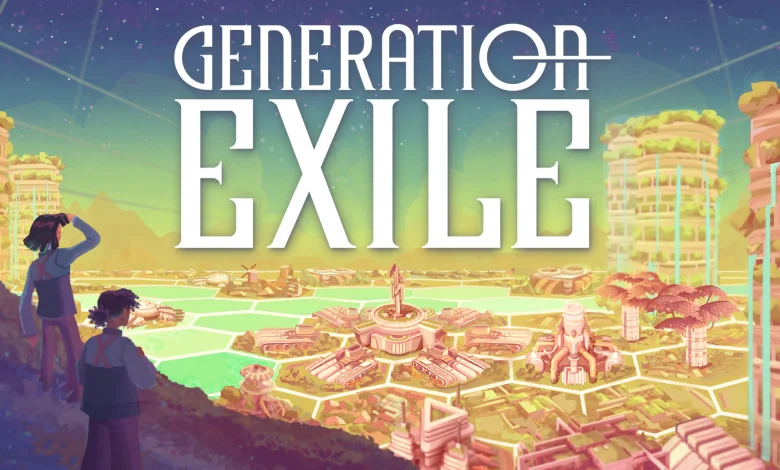

Generation Exile had been on my radar for several months, back when it was in Early Access and I saw it recommended on Steam. It drew me in due to its theme: interstellar travel on a generation ship where we are called upon to manage limited resources. Additionally, the game has a solarpunk aesthetic - a charmingly optimistic prediction of future aesthetics that is rare compared to the more common post-apocalyptic gray.

The game is the debut of the Canadian Sonderlust Studios, a small team of quite experienced developers. One of the two founders, Nels Anderson, previously worked on Firewatch and Mark of the Ninja, and the other co-founder, Karla Zimonja, worked on Gone Home and Tacoma (as well as on the animation of my beloved Zoo Tycoon 2). The rest of the team also has experience in the field, with members having worked on various AAA titles.
The game entered EA in November 2025 and remained there until mid-April, when it was released in version 1.0. While in EA, the creators gradually provided narrative chapters and a demo, which I played at the time and found quite complete and pleasant. I will return at the end of the review with more on the production process and the final release of Generation Exile.

Starting with the genre, it’s somewhat... complex. We are dealing with city builder/colony management and production line mechanics, similar to the Anno series tradition, but on a hexagonal grid in the style and palette of the latest Civilization games, and similarly turn-based. Additionally, there is a narrative element that follows the creation of our character (the "Caretaker") and their accompaniment by two friends and assistants (the "Stewards"). Both during the creation of these -randomly generated- characters and throughout the game, we are given interaction choices through narrative vignettes, and depending on our choice, there are corresponding results.

Although the vignettes are very beautiful and well-made, and are accompanied by the extremely atmospheric music of Ben Prunty (Into the Breach, FTL, Subnautica), throughout the game they seemed disjointed from the general story progression, and their impact on our colony was most of the time unclear. Specifically, it seems their existence is due to an attempt to create a connection and empathy between the player and the colony crew through our assistants. The chosen method is in the style of Crusader Kings (another genre added to the mix). So, the assistants have stat sheets with their characteristics, traits, quirks, and a... family tree. Of course, in the end, no real depth is given to these characters beyond the random events in the vignettes, so I feel that this mechanism was included more as a gimmick and a "hook" rather than serving any organic purpose. A family tree feels different when you can trace, for example, your characters' generation in CK III back to Octavian, St. Peter, and Muhammad, versus when it's just randomly generated names for randomly generated characters and their ancestors.

Moving on to gameplay, the game is divided into narrative chapters, which dictate the degree of freedom in building the colony and the pace at which we proceed depending on the threat. In the first chapter, we start by emerging onto the surface of the ship's biomes after years of abandonment and marginal ecosystem collapse. Theoretically, the core gameplay mechanism is the need for sustainability and the recycling of limited resources. So, while initially we build water towers for the colony's buildings, later we demolish them to replace them with something else—both spatially, since space is limited, and to use the resources of the former. Practically, however, throughout the entire game, up to its conclusion, it was never made clear or felt to me that there was a scarcity of materials.

Later in the game, we manage to move to the next ecosystem, the Taiga. There, we face other challenges as we must also keep in mind heating or logging to ensure construction raw materials. The ecosystem there is plagued by a parasitic insect invasion that affects the trees, and we must simultaneously investigate the source of the infection and find a way to deal with it. A sense of urgency is added to the gameplay with a crisis meter. If three crises are running simultaneously—for example, wood-eating beetles, lack of heating, and feelings of loneliness due to a lack of entertainment—then a 10-turn countdown to game over begins. However, these conditions are always easily manageable and will never truly threaten you.
At the same time, there is a second destruction meter that depends on the tasks our assistants perform. Building a new structure or moving/destroying one engages an assistant. But assistants are also necessary for other activities like researching beetles, dealing with a breakdown, and setting up social activities. They always manage to complete the assigned project, but depending on their particular characteristics, they have a chance to cause either a crisis or euphoria. If many crises occur in a row, a vignette with some destruction, small or large, occurs. Euphoria gives us extra points that we can use to upgrade buildings and make them more efficient.

At the end of this chapter, through a narrative device, we jump years ahead in the colony and return to find our assistants older and aged, and the ship facing new problems—easily solvable within a few turns, however. We end up unlocking a new biotope, the tropical jungle. There, due to a failure of the ship's shielding, cosmic radiation permeates it, and it becomes clear that the whole colony is in danger of the same fate. This chapter is inconsistent with the previous ones, as we are very quickly led to build a production line that solves the problem. When this chapter also ends, we are led to the escalation: the preparation for the arrival at the planet that will become our new home. This mode is called "Planetfall" and is essentially sandbox play in all biomes with some specific production goals. This is, in essence, the free play mode we can play versus the Story Mode I described so far.

All this holds true generally if the player's experience goes smoothly. From a graphics and sound perspective, I personally had no problem and found them well-made and high-level. The UI has some minor issues, there is still quite a lot of placeholder text, and especially in the last phase of Planetfall, there are quite a few minor problems. The main problem, however, is the existence of several bugs related to goal completion conditions and story progress. Between chapters, while a building should have been created automatically to allow trade between biotopes, in my case, it was never created. To the creators' credit, as soon as I made a bug report, they immediately released a patch that solved the problem. However, I had a problem again in the next chapter between the stations' trade, which was only solved when I started the last phase as a new game. And although up to that point I could understand and accept minor problems, during Planetfall, the game became essentially unplayable. There, the player is just asked to gather resources in storage, and the game updates the required meters. The meters either froze or worked erratically, and in general, there was no sense of what exactly needed to be done as a condition for the number to progress. With much patience, I somehow managed to overcome them and reach the end... where the final end screen froze, and I never managed to see how the game ends, draining whatever goodwill I had left until then.

Concluding this critique and my experiences, I must also refer to the production process of Generation Exile itself. While I generally feel it was made with love and care and it is apparent that the team behind it had experience, I had the impression that the initial stages of the game and the tying of the narrative to the gameplay, as well as the later stages, were uneven. This made me think that the final stage was released in a hurry and generally the game proceeded to full release without being completely ready. For anyone who made it this far and is willing to look more specifically at the production path of this particular game and the problems that may plague indie development, they can see the reflections of the creator Nels Anderson himself here. εδώ.
Complementary to the themes the creator touches on regarding the promotion of a new studio in a fairly saturated space, I will add that in terms of design, there must be a clarity for a game's mechanisms. When playing it, it must be apparent that the mechanisms have a reason to exist and are not just there as hooks. Additionally, I believe Generation Exile suffers from a fairly common disease for the indie space, that is, focusing the weight on the aesthetic part, leaving the mechanisms that will make the people who play it stay and return to the game anemic. The final sin, I consider, is the existence of several bugs in the final game, especially when it comes from a multi-month stay in the Early Access waiting room. Nels wonders in his post about the reluctance of players to buy titles in EA as well as the stigma that seems to remain on titles that choose it. Indeed, as I have expressed myself in the past, the Early Access sign is initially a deterrent for me, both for fear that it will remain in the incubator forever and because often the full release is ultimately just a continuation of the EA path. This is a risky situation for small studios with limited budgets regarding the final fate of an incomplete game.
Overall, I would recommend that fans of Sci-Fi and experimental strategy games take a look at it when the price is right, at least for its narrative aspect.
RATING - 70%
70%
A solid debut. It stands out for its solarpunk aesthetic and well-designed vignettes, but it loses its way somewhere in the gameplay and stumbles over various bugs.