
1994 was undoubtedly a historic year for gaming, with many groundbreaking releases that left a permanent mark on the gaming landscape and continue to influence the industry and engage audiences and critics in one way or another to this day. Blizzard released Warcraft: Orcs and Humans, Looking Glass Studios unleashed System Shock on an unsuspecting world, LucasArts finally showed those Rebel scum who's boss with Star Wars: TIE Fighter, and we even have UFO: Enemy Unknown (in Europe at least, as in America it had already been released on December 31, 1993 under the name X-COM: UFO Defense), Heretic, Doom 2, Wing Commander 3, as well as the CD version of Quest for Glory 4 (the non-voiced floppy version had already been released a year earlier) and other excellent games that deserve a separate "Late to the Party" tribute of their own.
Amidst this barrage of releases, it is not surprising that several noteworthy but relatively lower-profile titles remained obscure and, at least as far as the majority of the public is concerned, were lost to the annals of history, unable to surpass the commercial success of the aforementioned "big players." One of these titles is Hammer of the Gods, a turn-based strategy game inspired by Norse mythology. It was created by Holistic Design and published by New World Computing, essentially combining elements from games that the two companies had released in the past (Holistic had given us Merchant Prince a year earlier, and NWC had released the famous King's Bounty in 1990). So, play your favorite Manowar album and crank it up to 11, and off we go on a journey to the era of northern legends...
“IRON MEN WITH IRON SOULS BROUGHT DEATH AND FIRE…”
The atmospheric intro cutscene accurately sets the tone for the game. According to the narrator's awesome voice, the historical context of HotG is set shortly after the collapse of the Western Roman Empire. The removal of the relative security provided by the once-powerful Roman army in the northern regions of Europe resulted in the increasingly frequent appearance of "northern warriors," the Vikings, who raided across Europe in search of wealth, glory, and Odin's favor.
 “To Moscow! To Moscow!"“
This era might be remembered with horror and dismay by most Western historians, but for our narrator, it was a time of "heroic deeds" and "the almighty gods of the North," who openly intervened in human affairs. So, one night, the four strongest Viking warriors traveled in their sleep on a magical ship to Asgard, where Odin welcomed them and challenged them to win the favor of the gods by completing a series of quests. The winner of this "competition" would prove his power over his rivals, and Odin would officially name him his chosen one on Midgard.
This introduction pretty much sums up the essence of the gameplay. Each of the four warriors who met Odin represents one of the available factions/races in the game (Humans, Elves, Dwarves, Trolls), and our goal is to lead our race to glory by completing a series of quests for the Norse gods, from the lesser and relatively unknown gods to Odin (each race has a different hierarchy of gods, but the superior "Aesir" gods are common to all), and earning for ourselves the eternal and infinitely cool title "Hammer of the Gods."
KILL WITH POWER!
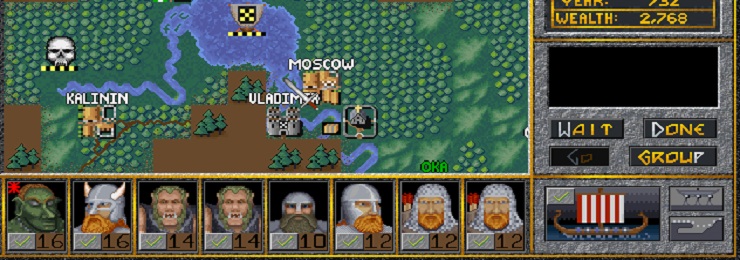
HotG is primarily a 4X strategy game (for those unfamiliar with the term, the Xs stand for "Explore, Expand, Exploit, and Exterminate"). Thus, the main action inevitably takes place on the World Map, where we control our units in order to explore, conquer cities, come into contact with rival factions and, sooner or later, fight them. Our units move on the map as in Merchant Prince and King's Bounty, using each unit's limited Move Points. Once all Units' Move Points are exhausted, our turn ends and the turns of the three opponents begin alternately. The cost in Move Points increases depending on the terrain (normal on plains, slightly increased in forests, rivers, and at sea if traveling by ship, greatly increased on hills and mountains), but it is possible to build a rudimentary road network (square by square and at the corresponding cost), which minimizes the Move Points a unit must "spend" to cross each square of the map.
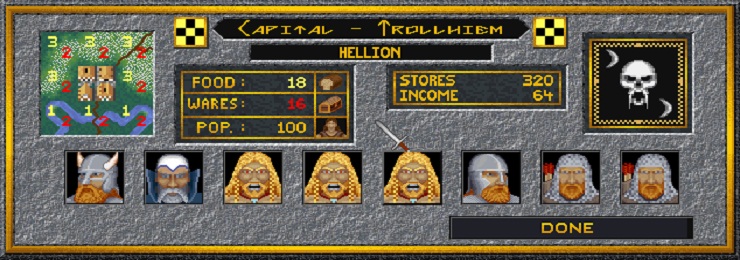 The capital of the Troll faction is called... Trollhiem. And yet, there was a time when this name didn't seem particularly funny.
Although the corresponding tab offers the possibility of limited diplomacy (mainly for establishing trade relations and alliances, sending gifts, or formally declaring war on an opponent), as one would certainly expect from a game where we control an all-powerful Viking warlord, the emphasis is on the military aspect (of course, a Viking game that would require you to behave politely and shower your clean and gentlemanly companions with compliments would be so subversive that it would border on being interesting). The way battles are conducted is clearly influenced by King's Bounty. Opposing armies are lined up at opposite ends of the battlefield, and each unit moves in turn. Once all units have made a move (melee or ranged attack depending on the unit, movement by one square, or Wait), the turn ends and the units start moving again in the same order from the beginning. If the battle is against a city and our side (as the attacker) wins, a screen appears at the end where we choose the... "intensity" of the looting we want to do: Raid (a little loot and limited losses for the city's population), Plunder (normal looting, with greater financial rewards and increased losses to the population), Raze (total destruction – we grab everything that can be moved, kill everyone, and the settlement now appears on the map as uninhabited) or Subjugate (similar to Raze, except that, if we wish, we can "spend" some of our army units to colonize the razed settlement and make it part of our empire).
Despite the obvious fun of conquering Europe and establishing a Viking Empire from London to Moscow and Venice simply in the name of Rock and Roll, our main concern is always Odin's challenge. So at any time we have access to the pantheon of our faction through the corresponding tab, where we select the Quest of the god we are interested in (the choice of gods follows a chain logic, so we must first appease the lesser gods before we can move up the hierarchy). These Quests range from very simple and bloodless, such as collecting a certain amount of money or exploring a point on the map, etc., to purely warlike (obligation to Raid, Plunder, or Raze a certain number of settlements). There is an equally wide variety of Quest Rewards. For our "services," we can receive magical items for our army, increased prosperity in cities around a specific type of terrain (water, forest, tundra, etc.), military units, automatic map exploration, magical ships, and more. The final challenge, Odin's Quest, is clearly the most difficult and varies depending on our race, but completing it results in our proud victory over our insignificant opponents and secures our status as Odin's chosen ones. Is there a better reward than that?
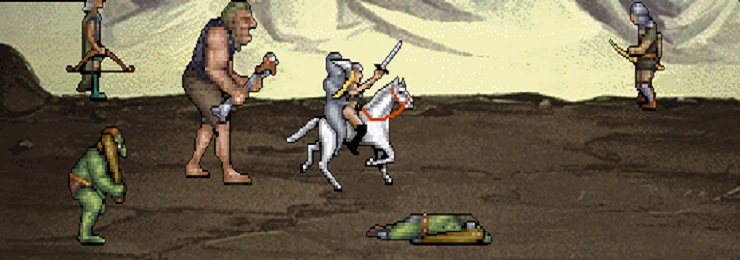 One of the most impressive instances in the game: if a "Hero" unit dies during battle, a Valkyrie appears from the sky to the sounds of Richard Wagner's Ride of the Valkyries, and lifts the soul of the dead warrior to carry it to Valhalla!
“ENSURE THAT HISTORY NEVER FORGETS THE NORSEMAN OR HIS GODS”.
Although Hammer of the Gods received good to excellent reviews in the press at the time, the reasons mentioned at the beginning of this article contributed to its relatively modest sales and, consequently, to it going almost unnoticed by the majority of the gaming public to this day. However, this does not detract from the fact that it remains a highly interesting strategy game that uniquely combines myth and fantasy and offers excellent replayability thanks to the differences between the four factions (both in terms of military units and their pantheon), the option to play on the "historical" European map or on a completely random-generated map, and its support for multiplayer. However, the game's most significant contribution to gaming history is the fact that it largely served as the basis for another great game that was released shortly afterwards, called Heroes of Might and Magic... but that is a tale for another time.

Ποπό, τι μου θύμισες τώρα….Το πρώτο μου strategy game ήταν!